


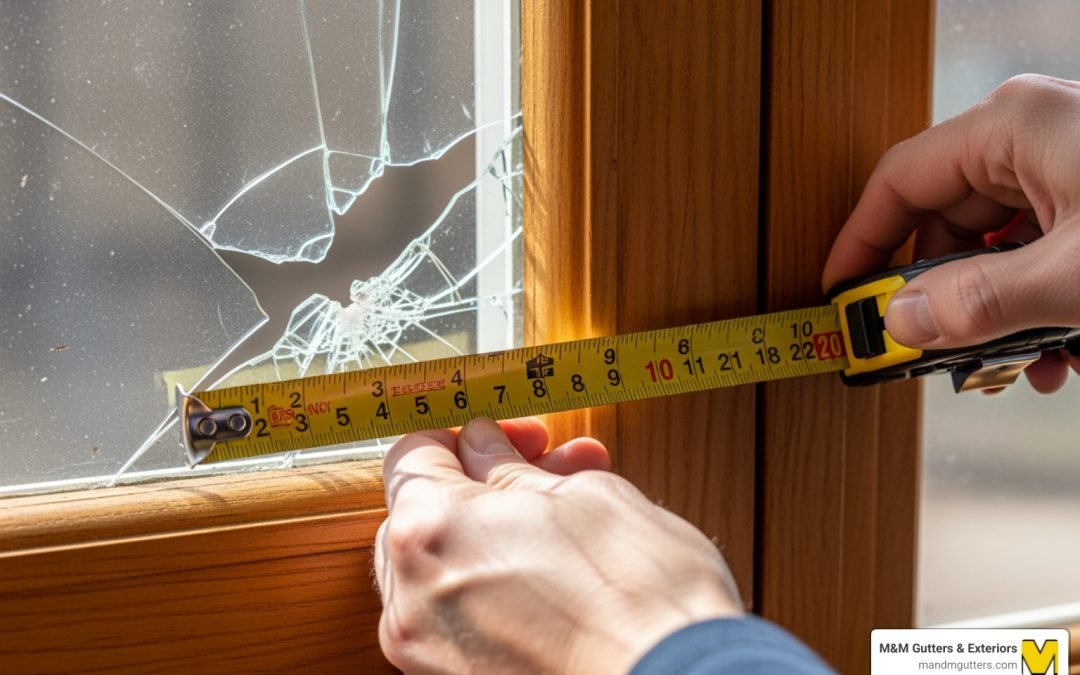
Why Getting Your Window Glass Measurements Right Matters
How to measure a window for glass replacement is simpler than most homeowners think — but small errors can mean cracked glass, air leaks, and wasted money.
Here’s the quick answer:
- Measure the width inside the frame at three points (top, middle, bottom) — use the smallest number
- Measure the height inside the frame at three points (left, center, right) — use the smallest number
- Round down to the nearest 1/8 inch
- Subtract 1/8 inch from both measurements to allow for clearance and expansion
- Check for square by measuring corner to corner diagonally — both measurements should match within 1/4 inch
That’s the core process. But the details — which part of the frame to measure from, how to handle out-of-square openings, and when to remove the old glass first — can make or break the job.
A cracked or foggy window isn’t just an eyesore. It drives up energy bills and can let moisture into your walls. Getting the measurements right before ordering glass saves you from a costly second trip to the glass shop.
I’m Nathan Nuttall from M&M Gutters & Exteriors, and after 30+ years helping Utah homeowners with exterior improvements — including countless window projects — I’ve seen how a few simple measurement mistakes can turn a quick fix into a frustrating ordeal; in this guide, I’ll walk you through exactly how to measure a window for glass replacement so you get it right the first time.
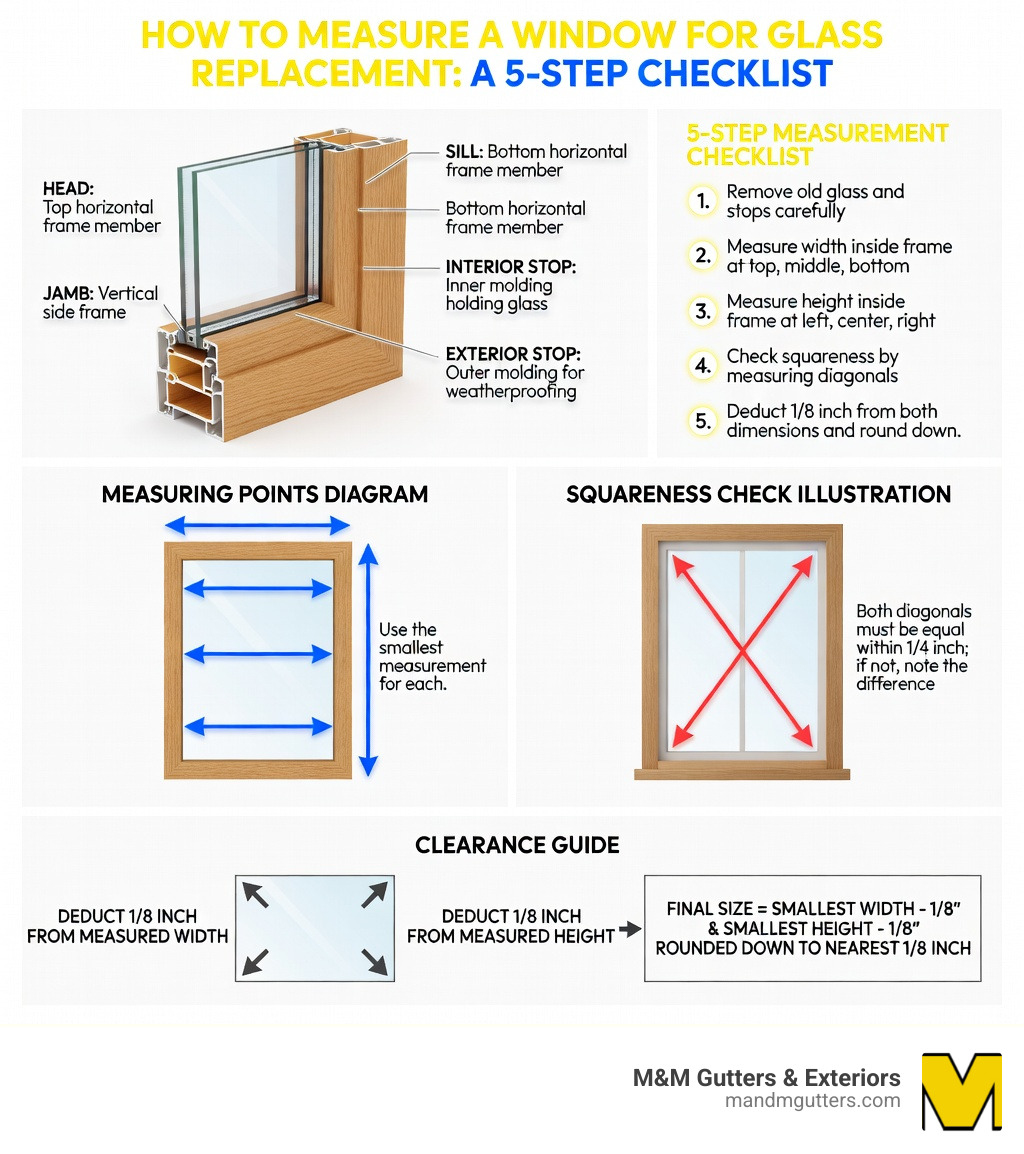
How to measure a window for glass replacement vocab explained:
Essential Tools and Preparation for Accurate Measurement
Before you grab your ladder and start pulling numbers, you need the right gear. Precision is your best friend here. If you are off by even a quarter of an inch, that expensive custom-cut glass becomes a very fragile paperweight.
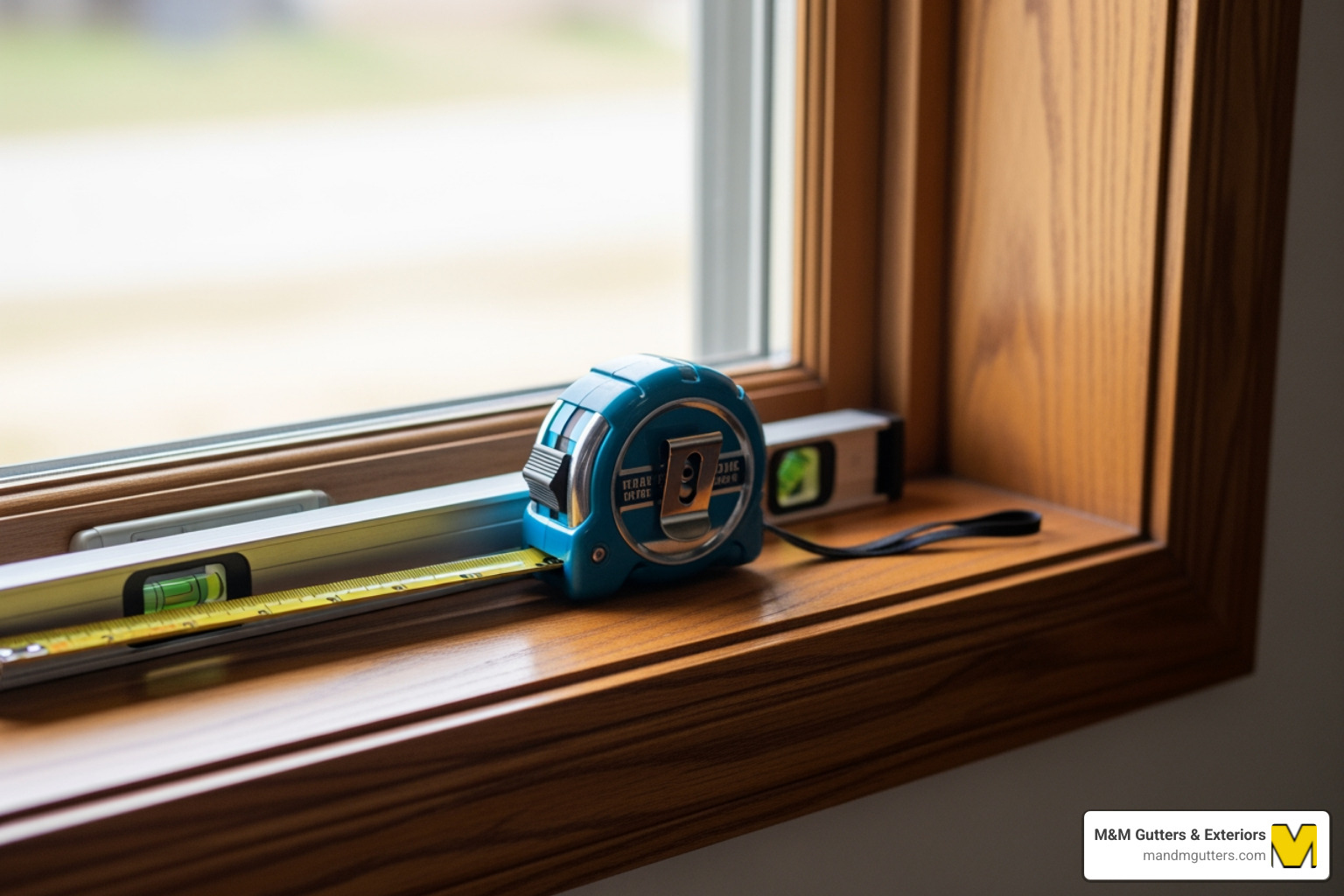
At M&M Gutters & Exteriors, we recommend gathering these tools before you begin:
- A High-Quality Steel Tape Measure: Avoid cloth or plastic tapes that can stretch. If you need a refresher, check out this video on How Do I Use a Tape Measure? for tips on taking accurate measurements.
- Safety Gear: Heavy-duty gloves and safety goggles are non-negotiable, especially if the existing glass is already cracked.
- Notebook and Pencil: Don’t rely on your memory. Write down every number immediately, labeling them clearly (e.g., “Kitchen Window – Top Width”).
- A Spirit Level: To check if your frames have shifted over time.
- A Step Ladder: To ensure you are looking at the tape measure head-on, avoiding “parallax error” where looking at an angle makes the number seem different than it is.
Checking for Square, Level, and Plumb
In a perfect world, every window is a perfect rectangle. In Northern Utah, where the ground shifts and older homes in Salt Lake City settle, “perfect” is rare. Before learning how to measure a window for glass replacement, you must check if the frame is still square.
To check for square, measure the diagonals. Run your tape from the top-left corner to the bottom-right corner, then from the top-right to the bottom-left. If the two numbers are within 1/4 inch of each other, the window is square enough for a standard glass replacement. If the difference is greater than 1/4 inch, the frame may be warped, and you might need a professional to adjust the frame or consider a full replacement window.
Plumb refers to the vertical straightness, while level refers to the horizontal. Use your spirit level on the side jambs and the sill. If the frame is significantly out of level, the new glass may not sit properly, leading to stress cracks later on.
How to Measure a Window for Glass Replacement: Step-by-Step
When people ask us how to measure a window for glass replacement, they often wonder: “Do I measure the glass I can see, or the hole it sits in?”
The answer: You are measuring the opening size (the “daylight” opening plus the depth of the pocket where the glass hides). However, the safest DIY method is to measure the inside of the frame where the glass is held.
For most modern windows, you’ll be measuring the space between the “stops” or the “jambs.” If you’re working with a double-hung window, be sure to check our double-hung window measurement handbook to ensure you aren’t accidentally measuring the wrong part of the sash.
Measuring the Width of the Window Opening for Glass Replacement
To get the width, you need to take three separate measurements. Frames can bow in the middle or pinch at the top.
- Top: Measure from the inside of the left jamb to the inside of the right jamb at the very top.
- Middle: Measure across the center of the glass.
- Bottom: Measure across the bottom, just above the sill.
The Golden Rule: Use the smallest of these three measurements. If the middle is 24 inches but the top is 23 7/8 inches, you must use 23 7/8. If you use the larger number, the glass simply won’t fit into the narrowest part of the frame. Always round down to the nearest 1/8 inch for precision.
Measuring the Height of the Window Opening for Glass Replacement
Height follows the same logic as width. You’ll measure in three spots:
- Left Side: From the high point of the sill to the top of the opening (the head jamb).
- Center: From the highest point of the sill in the middle.
- Right Side: From the sill to the head on the right.
Again, record the smallest height measurement. You should measure from the “high point” of the sill—this is the part of the bottom frame closest to the glass, not the decorative trim (the stool) that sticks out into your room.
Sizing for Success: Clearance and Glass Types
Once you have your smallest width and height, you aren’t quite ready to order. Glass expands and contracts with Utah’s temperature swings. If the glass fits too tightly, the pressure from the frame will cause it to shatter the first time we hit a 100-degree summer day or a sub-zero winter night.
Standard practice is to subtract 1/8 inch from your final width and height. This provides a 1/16-inch “expansion gap” on all sides. This clearance ensures the glass can be centered in the opening and sealed properly with glazing putty or silicone.
Understanding Window Depth and Specialty Frames
While width and height are the stars of the show, depth matters too—especially for double-pane units.
- Single-Pane Glass: Usually 1/8 inch or 3/16 inch thick.
- Double-Pane (IGUs): These are “sandwiches” of two glass panes with air or gas in the middle. You must measure the total thickness of the entire unit (often 1/2 inch to 1 inch). If you’re unsure about your options, read our guide on decoding window glass choices.
- The 3-1/4 Inch Rule: For a full replacement window unit to fit into an existing frame “pocket,” there usually needs to be at least 3-1/4 inches of depth between the interior and exterior stops.
Different window styles also require unique approaches. For example, measuring hopper windows in a basement often involves dealing with concrete or tight masonry openings, while awning and casement windows require you to account for the hardware and hinges that might obstruct your tape measure.
Avoiding Mistakes: When to Call a Professional
DIY glass replacement can save you money—typically costing $100–$300 per unit compared to $500–$1,000 for a pro-installed full window. However, the stakes are high. If you measure incorrectly, you own a piece of glass you can’t use.
There are times when measuring how to measure a window for glass replacement reveals a bigger problem. If you see any of these 11 signs you need new windows, glass replacement might just be a “band-aid” on a broken leg:
- Frame Rot: If the wood is soft or crumbling, it won’t hold new glass safely.
- Foggy Double-Panes: This means the seal has failed. While you can replace just the glass unit, often the frame is also reaching the end of its life.
- Severe Out-of-Square: If your diagonals differ by more than 1/2 inch, the house has settled significantly, and a new window unit is safer.
The Risks of Incorrect DIY Measurements
The most common mistake we see in Salt Lake County is homeowners adding a “buffer” in the wrong direction. They think, “I’ll make it a little bigger just in case,” and then the glass won’t fit. Or, they forget to account for the thickness of the glass in a double-pane unit, leading to a window that won’t close.
Incorrect measurements lead to:
- Air Leaks: If the glass is too small, even the best sealant won’t stop drafts.
- Moisture Buildup: Poorly fitted glass allows condensation to rot your interior wood.
- Safety Hazards: Tempered glass (required for doors and low windows) cannot be cut. If you order it wrong, it’s trash.
If the project feels overwhelming, it’s always better to find the best window installation near you to ensure the job is done with a warranty.
Frequently Asked Questions about Measuring Window Glass
Should I measure the existing glass or the window frame?
Ideally, you should measure the opening of the frame (the “sash rebate”). If the glass is already broken and you can safely remove a piece, you can measure the total height and width of the glass itself. However, measuring the frame and subtracting 1/8 inch is the standard method for windows where the glass is still installed.
How much should I subtract from my measurements for the new glass?
The standard deduction is 1/8 inch from both the total width and the total height. Some manufacturers may suggest 1/4 inch for very large windows to allow for more significant thermal expansion, but 1/8 inch is the “sweet spot” for most residential windows in Utah.
What if my window frame is not square?
If your diagonal measurements are off by more than 1/4 inch, you have two options. You can order the glass based on the smallest width and height and use extra glazing shims to center it, or you can hire a professional to “re-square” the frame. For screens, the process is slightly different, as you can see in our foolproof method for replacement screens.
Conclusion
Mastering how to measure a window for glass replacement is a valuable skill for any homeowner, but it requires a “measure twice, order once” mentality. By using the three-point measurement system, checking for squareness, and allowing for a 1/8-inch expansion gap, you can ensure a successful DIY project.
However, replacing just the glass doesn’t fix a warped frame, drafty seals, or poor insulation. If your windows are old, drafty, or difficult to open, a full replacement might be the smarter long-term investment for your home’s value and energy efficiency.
At M&M Gutters & Exteriors, we’ve spent over 30 years serving Salt Lake City, Davis, Weber, and Tooele counties. We don’t just guess—we use advanced 3D visualization tools like HOVER to ensure your exterior projects are perfect. Whether you need a simple glass fix or a full home exterior makeover, we’re here to help.
Ready to upgrade your home’s view? Contact us for more info about window replacement services or to schedule a consultation today!