


Why Accurate Measurements Matter for Your Window Project
How to measure double hung windows correctly is essential before ordering replacements. Here’s the quick method:
Quick Answer: Measuring Double Hung Windows in 4 Steps
- Width – Measure jamb-to-jamb at three points (top, middle, bottom). Record the smallest measurement.
- Height – Measure sill-to-head at three points (left, center, right). Record the smallest measurement.
- Depth – Measure jamb pocket depth (minimum 3 1/4 inches required for most replacements).
- Squareness – Measure diagonally corner-to-corner. Difference should not exceed 1/4 inch.
Getting your window measurements wrong leads to expensive mistakes, like windows that don’t fit or gaps that leak air and water. As one window expert notes, “Properly measuring windows is a good starting point for accurate replacement estimates and product selection.”
Accurate measurements ensure your new windows improve energy efficiency, block noise, and look professionally installed, saving you the headache of returns and delays. The good news is that measuring is straightforward with the right tools and a systematic approach. Whether you’re planning a DIY replacement or preparing for a professional quote, taking your own measurements helps you understand your project scope and budget.
I’m Nathan Nuttall from M&M Gutters & Exteriors. With over 30 years of serving Utah homeowners, I’ve seen projects succeed or fail based on this first critical step. This guide will walk you through the exact process our team uses to ensure every window fits perfectly.
Preparation is Key: Tools and Window Anatomy
Before measuring, gather the right tools and learn the basic window parts to prevent mistakes. This foundational knowledge is crucial, as you’ll be measuring the “essential parts of a double-hung window frame.”
Gather Your Tools
For accurate measurements, you’ll need a few essential tools. A reliable steel tape measure is most important for its rigidity and accuracy, as flexible tapes can stretch and give inconsistent readings.
Here’s what you’ll need:
- Steel Tape Measure: This is your primary tool. Make sure it’s long enough to cover the full height and width of your largest window. A good quality tape measure will have clear markings and a sturdy hook. If you need a refresher on how to use one effectively, there are many helpful resources like this video on using a tape measure.
- Pencil or Pen: For marking down your measurements.
- Notepad or Worksheet: A dedicated space to record your findings. We’ve found that a structured worksheet, like this replacement window measurement worksheet, helps keep everything organized and ensures you don’t miss any crucial details.
- Level: While not directly used for measuring dimensions, a level is indispensable for checking if your window is, well, level. This is part of assessing its squareness, which we’ll cover later.
- Pry Bar (Optional but Recommended): Sometimes, interior trim or old caulk might obstruct your measuring path. A small pry bar can help you gently remove trim or clear debris to get a clean measurement from jamb to jamb. Use it carefully to avoid damage!
Having these tools ready will streamline the process and reduce errors.
Understanding Window Parts
Knowing basic window anatomy is helpful so you know where to place your tape measure. This section covers the essential parts of a double-hung window frame to consider when measuring.
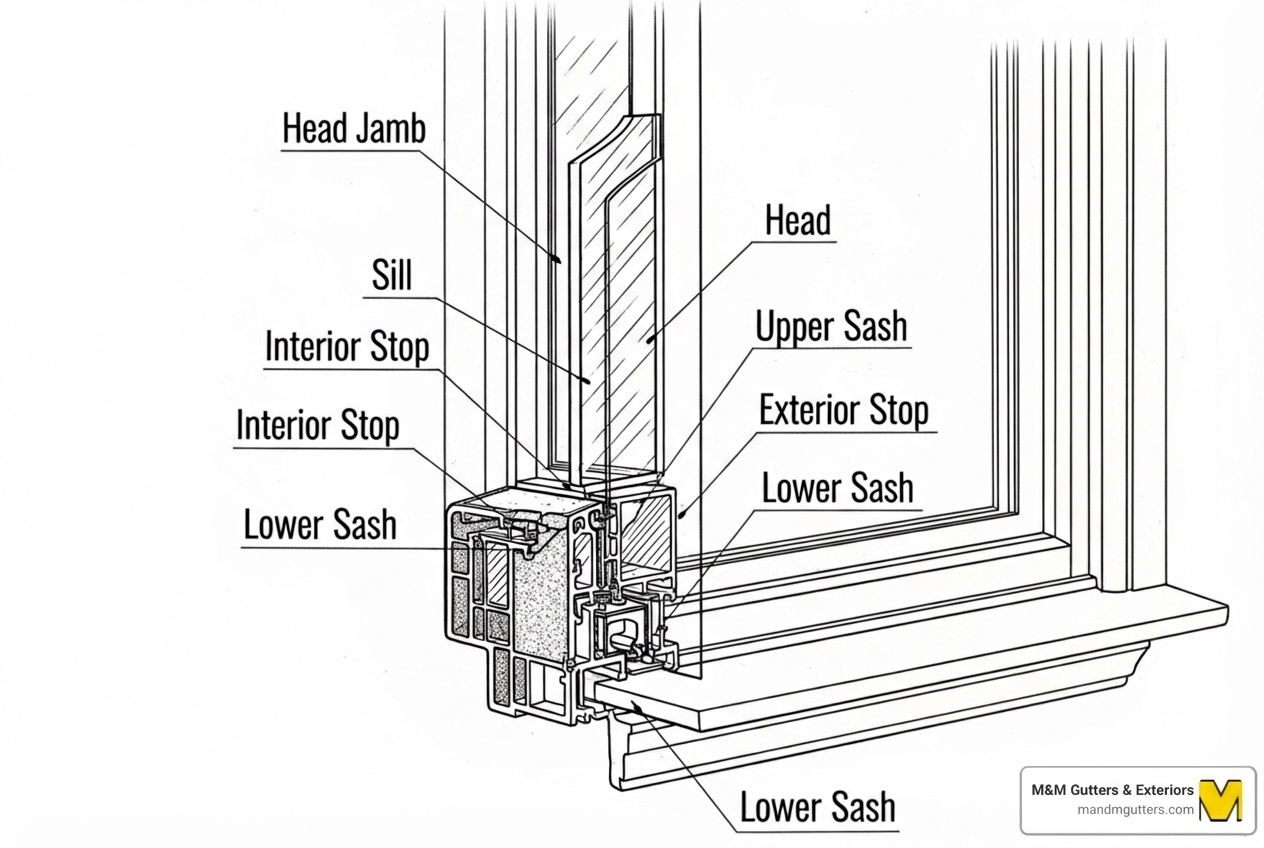
Here are the key components of a double-hung window frame you’ll be dealing with:
- Head: This is the horizontal component that forms the top of the window frame.
- Jambs: These are the vertical components that form the sides of the window frame. You’ll measure between these for your width.
- Sill: This is the horizontal component that forms the bottom of the window frame. It often slopes outward to shed water. You’ll measure from here for your height.
- Stops (Interior and Exterior): These are thin strips of wood or vinyl that hold the sashes in place and prevent them from moving too far in either direction. For depth measurements, you’ll often measure between these.
- Sash: In a double-hung window, there are two sashes—an upper and a lower. These are the movable panels that hold the glass. They can slide up and down independently, which is a defining feature of double-hung windows.
Knowing these terms will make following our measurement instructions much clearer. For a deeper dive, you can explore a guide to window anatomy.
How to Measure Double Hung Windows: A Step-by-Step Guide
Now for the main event: taking the measurements. The goal is precision. Always measure each window independently, even if they look identical, to prevent costly surprises.
Step 1: How to Measure the Width of Double Hung Windows
Measuring the width is typically the first step. For this, we’ll focus on the interior opening, specifically from jamb-to-jamb. This directly answers the question: “What are the specific steps for measuring the width of an installed double-hung window from the interior?”
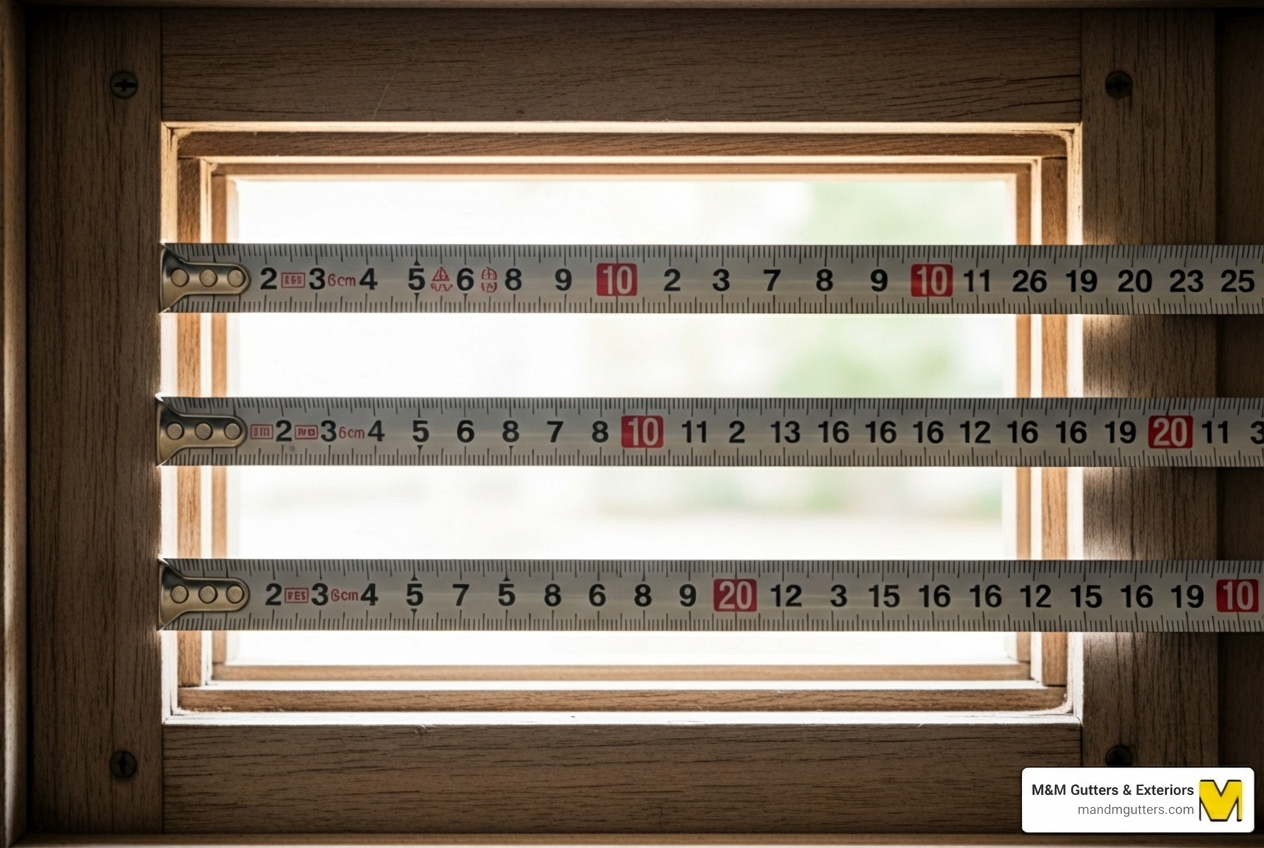
Here’s how we do it:
- Prepare the Area: Carefully clear any loose paint, caulk, or debris from the jambs. For some replacement projects, you might need to gently remove the existing sash and jambliners to get the most accurate “inside face of jamb to jamb” measurement.
- Measure at Three Points: This is crucial. Don’t just measure once! We take three distinct measurements across the width of the window opening:
- Top: Measure from the inside face of the left jamb to the inside face of the right jamb, near the top of the opening.
- Middle: Repeat the measurement across the middle of the opening.
- Bottom: Take the third measurement across the bottom of the opening.
- Record the Smallest Measurement: Your window opening might not be perfectly square or consistent from top to bottom. This is normal, especially in older homes in Salt Lake City and other Northern Utah areas. To ensure your new window will fit without forcing it, always use the smallest of these three width measurements. This guarantees the window will clear the narrowest point.
- Round Down: Once you have your smallest measurement, we recommend rounding it down to the nearest 1/8 inch. Some sources even suggest rounding down to the nearest 1/16 inch. This small allowance provides a necessary gap for shimming and insulation during installation, making the process much smoother. For example, if your smallest measurement is 35 3/16 inches, round down to 35 1/8 inches.
This method, measuring from “jamb to jamb or drywall to drywall from inside your home” at multiple points and using the smallest measurement, is a best practice across the industry to ensure a snug yet manageable fit.
Step 2: How to Measure the Height of Double Hung Windows
Next up is the height. Similar to the width, we’ll take multiple measurements to account for any inconsistencies in the opening. This addresses the question: “What are the specific steps for measuring the height of an installed double-hung window from the interior?”
Follow these steps:
- Identify Head Jamb and Sill: Locate the head (the top horizontal frame piece) and the sill (the bottom horizontal frame piece).
- Measure at Three Locations: Just like with the width, we’ll measure the height at three points:
- Left Side: Place your tape measure at the highest point of the sill (where the inside of the bottom sash meets the sill) on the left side and extend it straight up to the underside of the head jamb.
- Center: Repeat the measurement in the exact middle of the window opening.
- Right Side: Take the third measurement on the right side of the opening.
- Account for the Sloped Sill: Many sills, especially in older homes, are sloped to direct water away from the house. It’s crucial to measure from the highest point of the interior sill up to the head jamb. This prevents ordering a window that’s too tall for the shortest part of the opening.
- Record the Smallest Measurement: Again, use the smallest of these three height measurements. This ensures your new window will fit comfortably without needing to force it into a potentially uneven opening.
- Round Down: Just like with the width, round your smallest height measurement down to the nearest 1/8 inch (or 1/16 inch if preferred). This provides that essential wiggle room for installation.
By diligently following these steps, you’ll have accurate width and height measurements for your double-hung windows.
Step 3: Measure the Depth
While width and height get the most attention, depth is equally critical, especially for replacement windows. This measurement determines if a standard replacement window unit will fit within your existing wall structure.
- Jamb Depth: This refers to the distance from the inside face of the interior stop to the inside face of the exterior stop. Essentially, it’s the thickness of the wall opening where the window unit will reside.
- Minimum Requirement: For most replacement windows, there must be at least 3-1/4 inches of depth between the interior and exterior stops for a proper fit. Some manufacturers, like Lincoln, specify a jamb pocket depth of at least 3-5/16 inches. If your depth is less than this, or significantly more (e.g., greater than 3-3/8 inches), modifications may be necessary, or you might need a different type of window unit.
- How to Measure: To measure, open your lower sash halfway and place your tape measure at the interior stop, extending it straight across to the exterior stop. Ignore any pulleys or parting strips that might be in the way. Ensure you have enough space for the new window frame.
Failing to measure the depth accurately can lead to issues where the new window either protrudes too much inside or outside, or simply can’t be installed without extensive (and costly) modifications to your wall. For more detailed guidance, our How to Measure Replacement Windows Guide can provide additional insights.
Step 4: Check for Squareness
Even with precise width and height measurements, an out-of-square opening can cause significant installation headaches. This step directly addresses the question: “How do I account for slight imperfections or out-of-square conditions when taking measurements?”
Here’s how to check for squareness:
- Measure Diagonally:
- Place your tape measure in the upper-left corner of the window opening and extend it down to the lower-right corner. Record this measurement.
- Next, measure from the upper-right corner down to the lower-left corner. Record this second measurement.
- Compare the Measurements: Ideally, these two diagonal measurements should be exactly the same. However, in reality, especially in older homes in Utah, they often aren’t.
- 1/4 Inch Tolerance: For most standard replacement windows or sash kits, if the two diagonal measurements differ by no more than 1/4 inch, your opening is considered “square enough.” This small difference can usually be accommodated during installation using shims to level and plumb the new window.
- Out-of-Square Conditions: If the difference between your diagonal measurements is greater than 1/4 inch, your window opening is significantly out-of-square. This is an important finding! For replacement kits, a difference greater than 1/4 inch typically means the frame is too out-of-square, and a full-frame replacement might be a better (though more involved) option. If you’re checking to see if your windows are square, level, and plumb before proceeding, this step is paramount.
When an opening is out-of-square, ordering a new window based solely on the smallest width and height measurements might still work, but the installation will require more careful shimming to ensure the window operates correctly and looks good. Shims are small wedges used to fill gaps and provide a level, plumb, and square installation.
From Numbers to Orders: Understanding Your Measurements
Once you have your precise measurements, the next step is to understand what they mean for ordering your new windows. The type of project you’re undertaking will dictate how these numbers are interpreted and used.
Full Window Replacement vs. Sash-Only Kits
This section directly answers: “Are there different measurement requirements for ordering replacement sashes versus ordering a full window unit?” and “What is the ‘daylight size’ and how does it differ from overall window dimensions?”
Full Window Replacement (New Construction or Insert Windows):
When you’re opting for a full window replacement, you’re either removing the entire existing window frame down to the rough opening (often for new construction or severely damaged existing frames) or installing an “insert” window within the existing frame. In these cases, the measurements you just took – the smallest width and height from jamb-to-jamb and sill-to-head – are your primary dimensions. These measurements ensure the entire new window unit (frame included) fits within the existing opening.
- Rough Opening: If you’re doing a new construction installation or a full tear-out, you’ll be measuring the “rough opening,” which is the framed-in space in the wall where the window will eventually go. These measurements are typically slightly larger than the actual window unit to allow for shimming and insulation. However, for most homeowners replacing existing windows, you’ll be measuring the existing window frame’s interior dimensions as described in Steps 1-4.
- Overall Window Dimensions: This refers to the exterior dimensions of the entire new window unit, including its frame. When you provide your opening measurements to a manufacturer or supplier, they will typically subtract a small amount (e.g., 1/4 to 1/2 inch) from your smallest width and height to create the “actual unit size.” This ensures the new window unit is slightly smaller than the opening, allowing for easy installation, shimming, and proper sealing.
Sash-Only Kits (or Replacement Sashes):
Sometimes, your existing window frame is in good condition, but the sashes (the movable parts with the glass) are old, drafty, or damaged. In this scenario, you might opt for replacement sashes or a sash-only kit. The measurement requirements here are different and often more specific to the manufacturer.
- Sash Kit Measurements: For double-hung sash kits, you might only need to provide the width of the sashes (both top and bottom sashes will be the same width) and the height of the jambliner to the long point (the outer edge that follows the slope of the sill). The height of the actual sashes might not even be required, as they are often designed to fit standard industry heights for the opening. It’s critical not to measure the glass opening or include weatherstripping in your edge measurement for these types of orders.
- Glass-Only Measurement: For certain purposes, like ordering replacement glass or specific window treatments, you might only need the dimensions of the glass itself. This is often related to “daylight size.”
What is ‘Daylight Size’ and How Does it Differ?
The ‘daylight size’ (also known as “visible glass area”) is a term that refers specifically to the dimensions of the glass in a window, or more precisely, the overall measurement of the width and height of where the glass meets the wood or frame on a window sash. It’s the unobstructed viewable area of the glass.
- How it’s Measured: You typically measure from the edge of the sash where the glass meets the wood/frame to the opposite edge of the outermost glass pane.
- Difference from Overall Dimensions: Unlike overall window dimensions (which include the entire frame), ‘daylight size’ excludes the frame, jambs, and stops. It’s purely about the glass.
- When to Use It: ‘Daylight size’ is usually needed for specific products like custom window inserts (e.g., insulating panels that fit over the glass) or for cleaning services that charge by glass area. For example, if you’re getting a quote for window cleaning, they often ask for the “daylight size, interior measurement” of your double-hung windows.
So, while overall window dimensions (width, height, depth) are crucial for ordering a full replacement unit, ‘daylight size’ and specific sash measurements are important for specialized products or services. Knowing the difference ensures you provide the correct information for your project. If you’re seeing signs you need new windows for your home, understanding these distinctions will guide your ordering process.
Recording Your Measurements Accurately
Once you’ve taken all your measurements, recording them clearly and systematically is just as important as the measuring itself. This directly answers the question: “What are the recommended practices for recording and reporting window measurements?”
- Use a Consistent Format (Width x Height): The standard way to report window dimensions is always Width x Height. So, if your smallest width measurement was 30 inches and your smallest height was 50 inches, you’d record it as “30 x 50.”
- Label Each Window Clearly: It might sound obvious, but we’ve seen enough mix-ups to know it’s worth emphasizing: label each window! Assign a unique identifier to each window (e.g., “Living Room West,” “Bedroom 1 North,” “Kitchen Window”). You can even sketch a simple floor plan and mark the windows with their corresponding labels.
- Include Depth and Diagonal Notes: Don’t forget to record your depth measurement and any notes about squareness (e.g., “diagonals within 1/4 inch” or “out-of-square by 1/2 inch”). This additional information is vital for your installer or supplier.
- Double-Check Everything: Before you put that tape measure away, take a moment to double-check all your recorded numbers. A quick re-measure of one or two critical dimensions can catch an error before it becomes a problem. Have a friend or family member verify your readings for an extra layer of confidence.
- Use a Worksheet: We highly recommend using a dedicated worksheet to keep track of all your window measurements. This helps ensure consistency and that you capture all necessary data points. You can download our replacement window measurement worksheet to help you organize your project.
By following these practices, you’ll have a clear, accurate record of your window dimensions, making the ordering process smooth and stress-free.
Frequently Asked Questions about Window Measurements
We often get questions from homeowners in Salt Lake County, Utah County, and beyond about specific scenarios when measuring double-hung windows. Here are some of the most common ones.
How do measurements for cleaning differ from measurements for replacement?
This is an excellent question that highlights the importance of context in measuring. The key considerations for measuring double-hung windows for specific purposes like cleaning versus replacement are quite different:
- For Cleaning Services: When you’re measuring for a cleaning service, they typically only need the “daylight size” or the visible glass area. This is because they’re cleaning the glass, not installing a new frame. You’d measure the width and height of the actual glass pane, usually from where the glass meets the frame or sash. You don’t need to worry about the frame’s depth, squareness, or the overall opening dimensions. It’s a simple, straightforward “glass only, interior measurement.”
- For Replacement (Full Window Unit or Sash Kit): For replacement purposes, you need much more comprehensive measurements. As we’ve detailed, this includes:
- Smallest width (jamb-to-jamb at three points).
- Smallest height (sill-to-head at three points).
- Jamb depth (interior stop to exterior stop).
- Diagonal measurements to check for squareness.
- Potentially, details about the existing sill angle or exterior stop width for specialized kits.
The goal for replacement is to ensure the entire new unit (frame and sashes) fits perfectly into the existing structural opening, allowing for proper insulation, sealing, and operation. Therefore, you need the full opening dimensions, not just the glass.
What if my window frame is rotted or damaged?
Finding rot, water damage, or significant structural issues in your window frame is a major red flag. This directly answers the question: “When should I consider calling a professional for window measurements instead of DIY?”
- Stop Measuring (for now): If you uncover significant rot, brittle wood, or other structural damage, especially around the sill or jambs, it’s often a sign that a simple replacement window (insert style) may not be sufficient. The existing frame’s integrity is compromised, and simply putting a new window into a rotting structure is a recipe for future problems.
- Consider a Full-Frame Replacement: For frames with extensive rot or damage, a full-frame replacement is usually necessary. This involves removing the entire old window, including the frame, down to the rough opening. This allows for repair of any damaged framing, proper waterproofing, and then installation of a brand-new window unit.
- Out-of-Square Beyond Tolerance: Similarly, if your diagonal measurements show that the frame is severely out-of-square (differing by more than 1/4 inch, or even 1/2 inch in some extreme cases), this indicates a structural issue. While some minor out-of-square conditions can be corrected with shimming, a significant deviation might mean the opening itself is warped or settling, making it unsuitable for a standard replacement insert without major structural work.
- Call a Professional: In these situations, we strongly recommend calling a professional. Our team at M&M Gutters & Exteriors specializes in assessing these conditions. We can determine the extent of the damage, advise whether a full-frame replacement is needed, and handle the complex measurements and structural repairs required. Attempting a DIY installation into a damaged or severely out-of-square opening can lead to poor performance, leaks, and even more costly repairs down the road. This is especially true for homes in the diverse climates of Summit County or Tooele County, where weather exposure can exacerbate frame issues.
Should I round my measurements up or down?
This is a common point of confusion, but the answer is straightforward and consistent across the industry:
- Always Round Down: When taking your smallest width and height measurements, always round them down to the nearest 1/8 inch (or 1/16 inch).
- Why Round Down? It is much easier to install a window that is slightly too small and use shims to fill the small gaps, ensuring it is plumb, level, and square. If you round up, or don’t round down at all, and the window is even a fraction of an inch too large for the narrowest or shortest point of your opening, it simply won’t fit. You’d then be faced with the costly and time-consuming problem of returning the window or having to cut into your home’s framing, which is a big job. A slight gap (e.g., 1/8 inch on all sides) is easily filled with shims, insulation, and caulk, creating a perfectly sealed and energy-efficient installation.
Conclusion: Measure with Confidence
You now have the knowledge to measure your double-hung windows accurately, taking the guesswork out of your next project. We’ve walked you through gathering the right tools, understanding window anatomy, and executing the four critical steps for measuring width, height, depth, and squareness. We’ve also clarified the nuances between “daylight size” and overall dimensions, and how measurement needs vary for cleaning versus replacement projects.
Precise measurements are the foundation of a successful window replacement. They ensure a perfect fit, optimize energy efficiency, and prevent costly mistakes. Whether you’re preparing for a DIY installation or getting a quote, armed with accurate numbers, you’ll approach your project with confidence.
However, if you encounter significant damage, a severely out-of-square frame, or simply feel the project is too complex to tackle on your own, that’s precisely when our expertise comes in handy. The experienced team at M&M Gutters & Exteriors is ready to help homeowners across Salt Lake City, Salt Lake County, Utah County, Summit County, Tooele County, Davis County, and Weber County. For a professional consultation and expert installation of your new windows, contact us today. Let us take the worry out of your window project, ensuring a beautiful, energy-efficient, and perfectly installed outcome for your Utah home.