


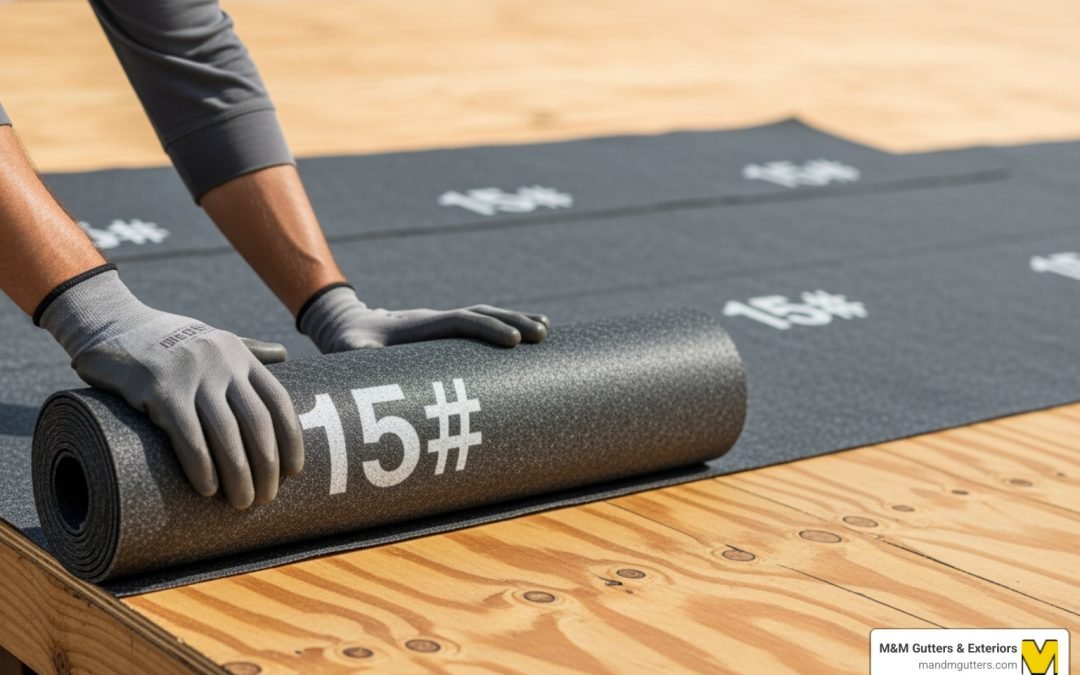
Why Understanding 15 Pound Felt Matters for Your Roof
15 pound felt is a lightweight roofing underlayment made from organic felt paper saturated with waterproofing asphalt. Here’s what you need to know:
Quick Facts:
- Weight: Approximately 11.5 lbs per 100 square feet (net mass)
- Coverage: 432 sq. ft. per standard roll (36″ x 144′)
- Purpose: Secondary water barrier under shingles, shakes, or tiles
- Standards: Meets ASTM D226 Type II and CSA A123.3 requirements
- Best For: Steep-slope roofs with asphalt shingles in standard weather conditions
When planning a roofing project, you’ve likely heard contractors mention “15 pound felt.” This material is your roof’s second line of defense, sitting between the roof deck and shingles to shed any water that gets underneath. The “15 pound” name refers to its traditional weight per 100 square feet, though modern versions are often lighter due to improved manufacturing.
This breathable membrane allows moisture vapor to escape while keeping water out, which is crucial for preventing wood rot and extending the life of your roof. It’s designed to be easy to install, cost-effective, and perfectly adequate for most residential roofing projects in moderate climates.
The question isn’t whether 15 pound felt works—it does. The question is whether it’s the right choice for your specific situation.
I’m Nathan Nuttall, and with over 30 years at M&M Gutters & Exteriors, I’ve seen how the right underlayment impacts roof performance in Utah. Let me walk you through the details so you can make the best decision for your home.
Understanding the Basics of 15 Pound Felt
15 pound felt, often called “roofing felt” or “asphalt felt,” is a foundational component in many traditional roofing systems. It provides an essential layer of protection between your roof deck and the visible roofing material, like shingles. For a broader look at common roofing materials, check out our guide on Roofing Materials and Types.
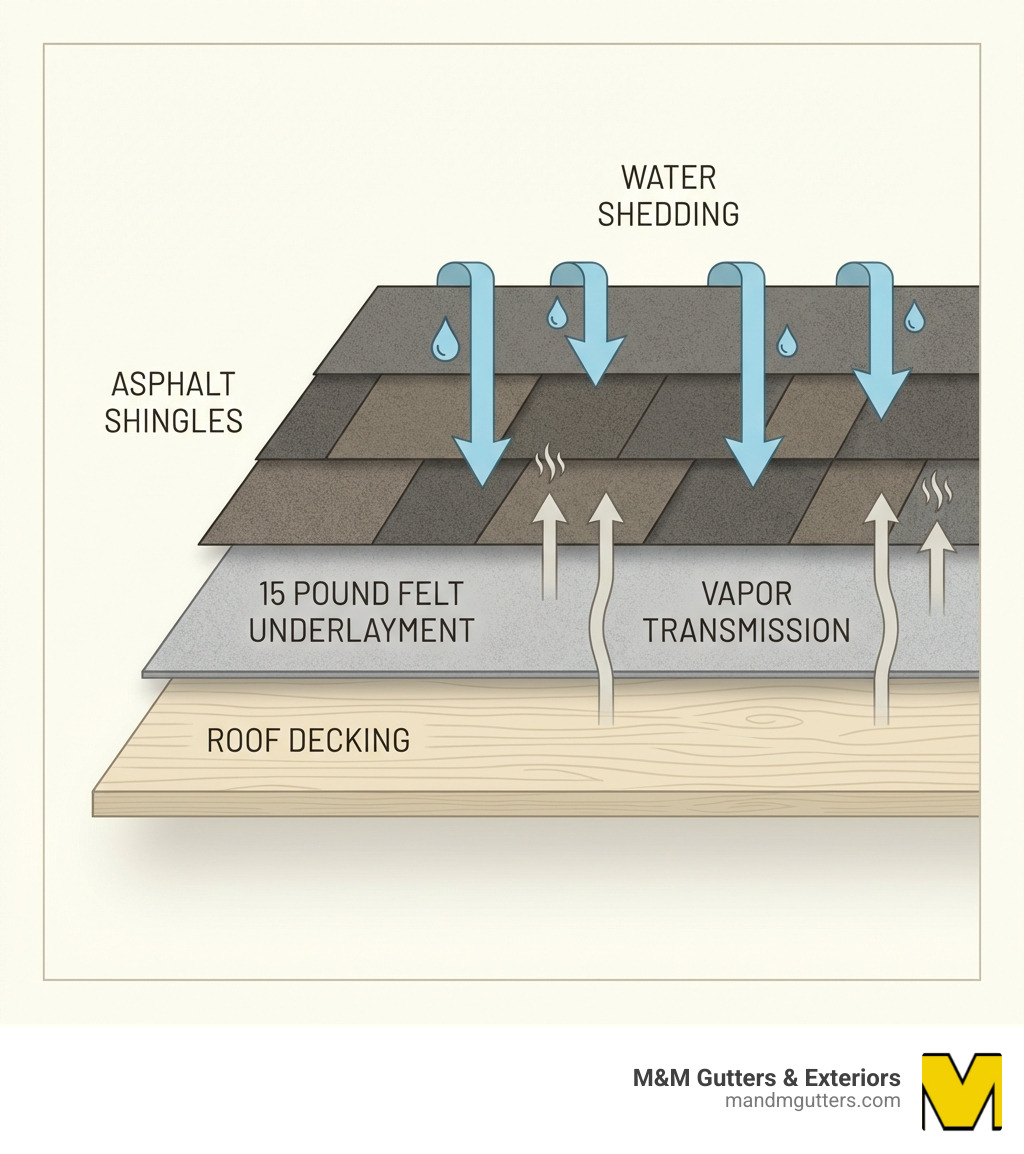
The core of 15 pound felt is an organic mat, often made from recycled wood pulp, that is thoroughly saturated with waterproofing asphalt. This process gives the felt its water-resistant properties. The net mass of the saturated felt is at least 11.5 lb per 100 square feet.
One of its key benefits is the balance of water shedding and breathability. While it blocks water that might get under your shingles, it also allows moisture vapor from inside your home to escape. This “breathable membrane” characteristic is crucial for preventing humidity buildup that can lead to wood rot and mold, especially in Utah’s varied climate. Some advanced versions even feature perforations to improve this breathability, helping the felt lay flat for a smoother installation.
In short, 15 pound felt is an engineered component that protects your home from the elements, manages moisture, and provides a stable base for your shingles.
Key Characteristics of 15 Pound Felt
The “15 pound” name historically referred to its weight per 100 square feet. While modern versions are lighter (around 11.5 lbs), the name has stuck. This weight class offers several advantages:
- Lighter Weight: Compared to heavier felts, it’s easier to handle and install. A standard 432 sq. ft. roll is manageable for roofing crews, leading to more efficient and cost-effective installation.
- Flexibility: Its pliable nature allows it to conform easily to the contours of a roof, including valleys and hips. This ensures a smooth, wrinkle-free underlayment, which is vital for the final appearance and performance of your roof.
- Ease of Installation: The combination of light weight and flexibility makes installation faster. Many products include printed guidelines to help with alignment, ensuring a precise and efficient job.
- Cost-Effectiveness: 15 pound felt is a budget-friendly option that provides excellent protection for most standard residential roofs, particularly those with asphalt shingles. It offers a great balance of performance and price.
In terms of strength, 15 pound felt is robust enough to withstand the stresses of installation and provide a durable secondary water barrier.
Material Standards and Certifications
To ensure quality and safety, we only use materials that meet stringent industry standards. For 15 pound felt, these certifications provide peace of mind that the product will perform as expected. Key standards include:
- ASTM D226 / D4869: These are standards from ASTM International, a globally recognized organization that develops technical standards. These specifications cover asphalt-saturated organic felt for roofing and waterproofing, ensuring minimum requirements for weight, strength, and pliability.
- CSA A123.3: This is a standard from the Canadian Standards Association (CSA) for felt roll roofing products, ensuring they meet Canadian performance and safety benchmarks.
- UL Fire Classification: Many felt products are classified by Underwriters Laboratories (UL) for their fire performance as part of a complete roofing assembly. This classification provides an extra layer of reassurance about your home’s safety.
These certifications mean the 15 pound felt we install has been independently tested and verified to meet building codes and perform reliably under various conditions.
Head-to-Head: 15 lb vs. Heavier Roofing Felts (e.g., 30 lb)
Choosing between 15 pound felt and a heavier option like 30 pound felt is a common decision. The “pound” designation refers to the weight per 100 square feet, and the core difference is a lighter versus a heavier-duty material. Let’s compare.
Here’s a comparison of 15 pound felt and 30 pound felt based on key metrics:
| Metric | 15 Pound Felt | 30 Pound Felt |
|---|---|---|
| Traditional Weight | Approx. 15 lbs per 100 sq. ft. | Approx. 30 lbs per 100 sq. ft. |
| Net Saturated Mass | Min. 11.5 lb/100 sf | Min. 26.0 lb/100 sf |
| Mass of Saturant | Min. 6.2 lb/100 sf | Min. 15.0 lb/100 sf |
| Saturation (% by wt.) | Min. 120% | Min. 150% |
| Breaking Strength (MD/CD) | 30/15 lbf/in | 40/20 lbf/in |
| Roll Size (Standard) | 36″ x 144′ (432 sq. ft.) | 36″ x 72′ (216 sq. ft.) |
| Roll Weight (Approx.) | 34-52 lbs | 56-58 lbs |
| Thickness | Thinner (relative to 30 lb felt) | Thicker (relative to 15 lb felt) |
| Tear Resistance | Good, but less than 30 lb felt | Excellent, higher than 15 lb felt |
| Permeability (Vapor) | More breathable (allows more vapor transmission) | Less breathable (allows less vapor transmission) |
| Cost-Effectiveness | Generally more economical | Generally more expensive |
| Durability | Good for secondary protection | Superior, offers improved protection |
| Puncture Resistance | Lower | Higher |
| Lifespan (Exposure) | Shorter (during construction) | Longer (during construction) |
As the table shows, 30 pound felt is a heavier-duty version of 15 pound felt. It contains more asphalt, making it thicker, stronger, and more resistant to tears and punctures. This makes it better at withstanding foot traffic and longer exposure during construction. However, it’s also heavier, less flexible, less breathable, and more expensive.
When to Choose 15 Pound Felt for Your Project
For many homeowners in the Salt Lake City area, 15 pound felt is an excellent and sufficient choice. It’s ideal for these applications:
- Steep-Slope Roofs: On roofs with a good pitch, water sheds quickly, making 15 pound felt a perfect secondary barrier against wind-driven rain.
- Asphalt Shingle Roofs: This is the most common and widely accepted pairing. It provides a smooth surface and reliable protection.
- Budget-Conscious Projects: It offers a smart balance of performance and price, delivering great protection without a high material cost.
- Standard Weather Conditions: For areas with typical weather patterns, a properly installed 15 pound felt system performs reliably.
When to Consider Heavier Roofing Felt
While 15 pound felt is a workhorse, some situations in Utah’s climate call for a heavier felt, like 30 pound felt, for extra protection:
- Low-Slope Roofs: On roofs with a shallow pitch (less than 4:12), water drains slowly. A thicker underlayment provides a more substantial water barrier.
- Heavier Roofing Materials (such as tile or slate): Heavy materials like tile or slate require an underlayment with superior puncture resistance and durability to withstand the installation stress.
- High-Wind Areas: In parts of Utah prone to high winds, a heavier felt’s greater tear resistance offers better protection against shingle blow-off.
- Regions with Heavy Rain or Snow: For mountainous areas that get heavy rain or deep snow, 30 pound felt provides a more formidable barrier against water intrusion. For more on this, read our article on Common Causes of Roof Leaks in Salt Lake City.
- Long-Term Exposure During Construction: If the roof deck will be exposed to weather for an extended time, 30 pound felt acts as a more robust temporary roof.
How to Install Roofing Felt: A Step-by-Step Guide
Proper installation is just as crucial as choosing the right material. At M&M Gutters & Exteriors, we follow strict best practices to ensure your underlayment provides optimal protection.
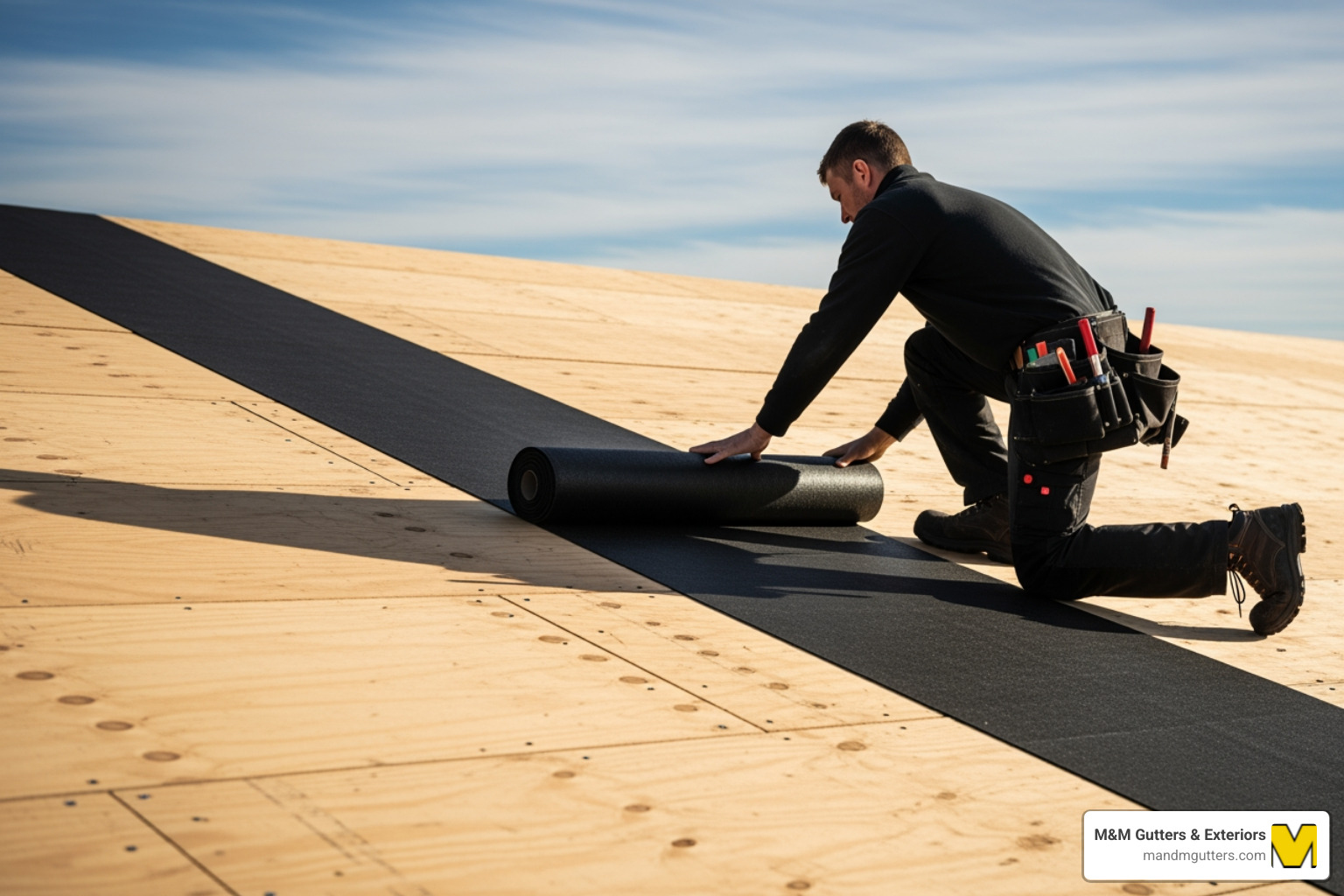
Roof Deck Preparation
Before we unroll any felt, the roof deck must be prepared. This foundational step is critical for the entire roofing system’s performance.
- Clean and Smooth: We remove all debris, old materials, and loose fasteners.
- Repair: Any rotted or broken decking is replaced, and loose nails are re-secured.
- Check Gaps: If new sheathing is used, we ensure proper expansion gaps are left to prevent buckling.
- Verify Ventilation: We confirm that attic ventilation is adequate to prevent heat and moisture buildup, which is crucial for Utah’s climate.
Wrinkle Prevention
A smooth surface is essential. We pull the felt tight as we unroll it to eliminate wrinkles, which can create weak spots. The felt is nailed down promptly to prevent shifting. If any wrinkles remain, they are slit, nailed flat, and sealed with flashing cement.
Safety Precautions
Roofing involves risks, and safety is our top priority. Our crews always use proper fall protection, wear slip-resistant footwear, and never walk on un-nailed felt, which can be slippery.
Essential Tools and Materials
For a precise and efficient installation, our crews use a specific set of tools:
- Hammer tacker or cap nailer
- Utility knife
- Corrosion-resistant roofing nails (11 or 12-gauge)
- Measuring tape and chalk line
- Flashing cement for sealing
Installation Best Practices
With the right tools and a prepared deck, our team follows a methodical approach for installing 15 pound felt.
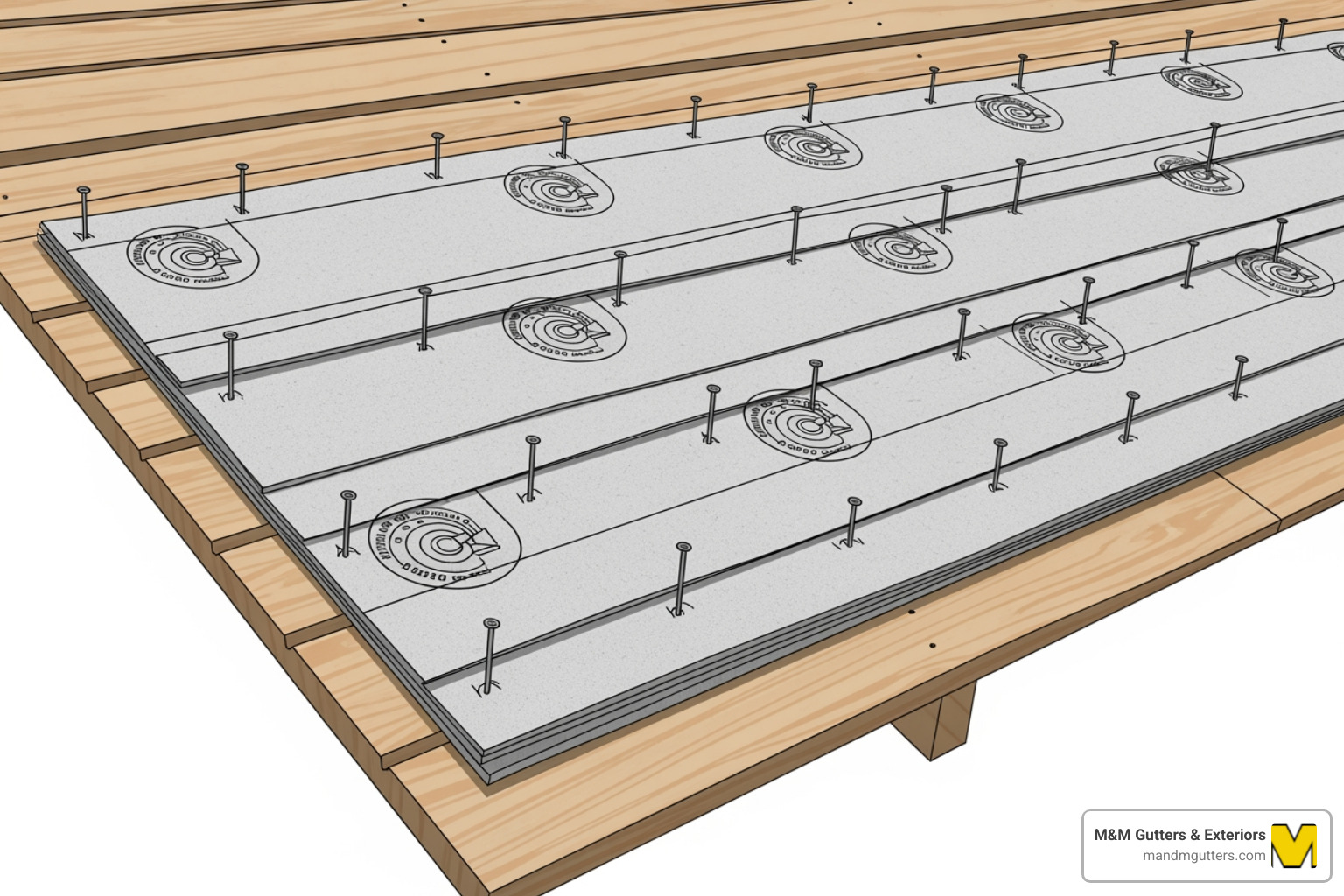
- Start at the Eaves: We begin at the lowest point of the roof and work our way up, ensuring layers overlap correctly to shed water.
- Horizontal Runs: Felt is run horizontally, parallel to the eaves, for consistent layering.
- 2-Inch Top Lap: Each course of felt overlaps the one below it by at least 2 inches, creating a shingling effect.
- 6-Inch End Laps: Where one roll ends and another begins, we create an overlap of at least 6 inches.
- Nailing Pattern: The felt is fastened with nails every 6 to 8 inches across the membrane to prevent shifting, especially in Utah’s high-wind areas.
- Ridge Overlap: The final layer overlaps the ridge by about 8 inches to protect the roof’s peak.
By adhering to these guidelines, we ensure your 15 pound felt underlayment provides reliable, long-lasting protection. For more tips, see our guide on How to Prevent Roof Damage During Utah Winters.
Frequently Asked Questions about Roofing Felt
We often get questions about 15 pound felt from homeowners in Salt Lake City. Here are some of the most common inquiries.
What are the dimensions and coverage of a standard roll of 15 lb felt?
A standard roll of 15 pound felt is typically 36 inches wide by 144 feet long, covering a total of 432 square feet. In roofing terms, this is about 4 “squares” (one square = 100 sq. ft.). A full roll usually weighs between 34 to 52 lbs.
Can I use 15 lb felt under different types of roofing?
Yes, 15 pound felt is versatile. It’s most commonly used under asphalt shingles but is also suitable for wood shakes, wood shingles, and some tile roofing. However, it’s crucial to consult the manufacturer’s specifications for both the felt and your primary roofing material. Some systems, especially in areas prone to ice damming, may require specialized underlayments. Understanding the right pairing is key, as we discuss in our comparison of Metal Roof vs. Shingles.
Where can I buy 15 lb roofing felt?
15 pound felt is a common construction material available at most local hardware stores, large home improvement retailers like The Home Depot or Lowe’s, and specialized building supply centers. While it’s easy to find, selecting the right brand and ensuring proper installation is a job for professionals. For expert advice and installation in Northern Utah, M&M Gutters & Exteriors is your trusted partner. We source high-quality materials and install them to perfection.
Conclusion: Making the Right Choice for Your Utah Roof
As we’ve explored, 15 pound felt is a critical component of a robust roofing system. It offers an excellent balance of secondary water protection, breathability, and cost-effectiveness, making it a great choice for many steep-slope asphalt shingle roofs.
However, the choice between 15 pound felt and a heavier underlayment isn’t about which is “better,” but which is right for your specific roof and local environment. Low-slope roofs, heavy roofing materials, or areas in Northern Utah with high winds and heavy snow may benefit from the superior durability of 30 pound felt. Correct installation is paramount—even the best material will fail if not applied with precision.
With over 30 years of experience serving homeowners across Utah, from Salt Lake County to Summit County, M&M Gutters & Exteriors understands our unique climate challenges. We don’t just sell a product; we provide a custom solution custom to your home and budget.
For professional advice and expert installation, explore our roofing services. Whether you’re curious about the cost of a roof replacement in Utah, wondering how long a roof lasts in Utah, or need a roof inspection, our team is here to help you get a durable, high-performance roof that protects your family for years to come.