


Why Ice Dams Make Heat Tape for Roofs Installation a Winter Essential
Heat tape for roofs installation is the process of securing electric heating cables along your roof’s eaves, gutters, and downspouts to melt snow and ice before it causes damage.
Here’s the quick version of how it works:
- Choose your cable – Self-regulating or constant wattage (self-regulating is best for most homes)
- Measure your roof – Eave length, overhang depth, valleys, and downspouts
- Install in a zigzag pattern – Along roof edges, 12-24 inches up from the eave
- Run cable through gutters and downspouts – To keep drainage paths open
- Connect to a GFCI-protected outlet – For safe, code-compliant power
- Test before winter hits – Visual check, power-on test, and sensor setup
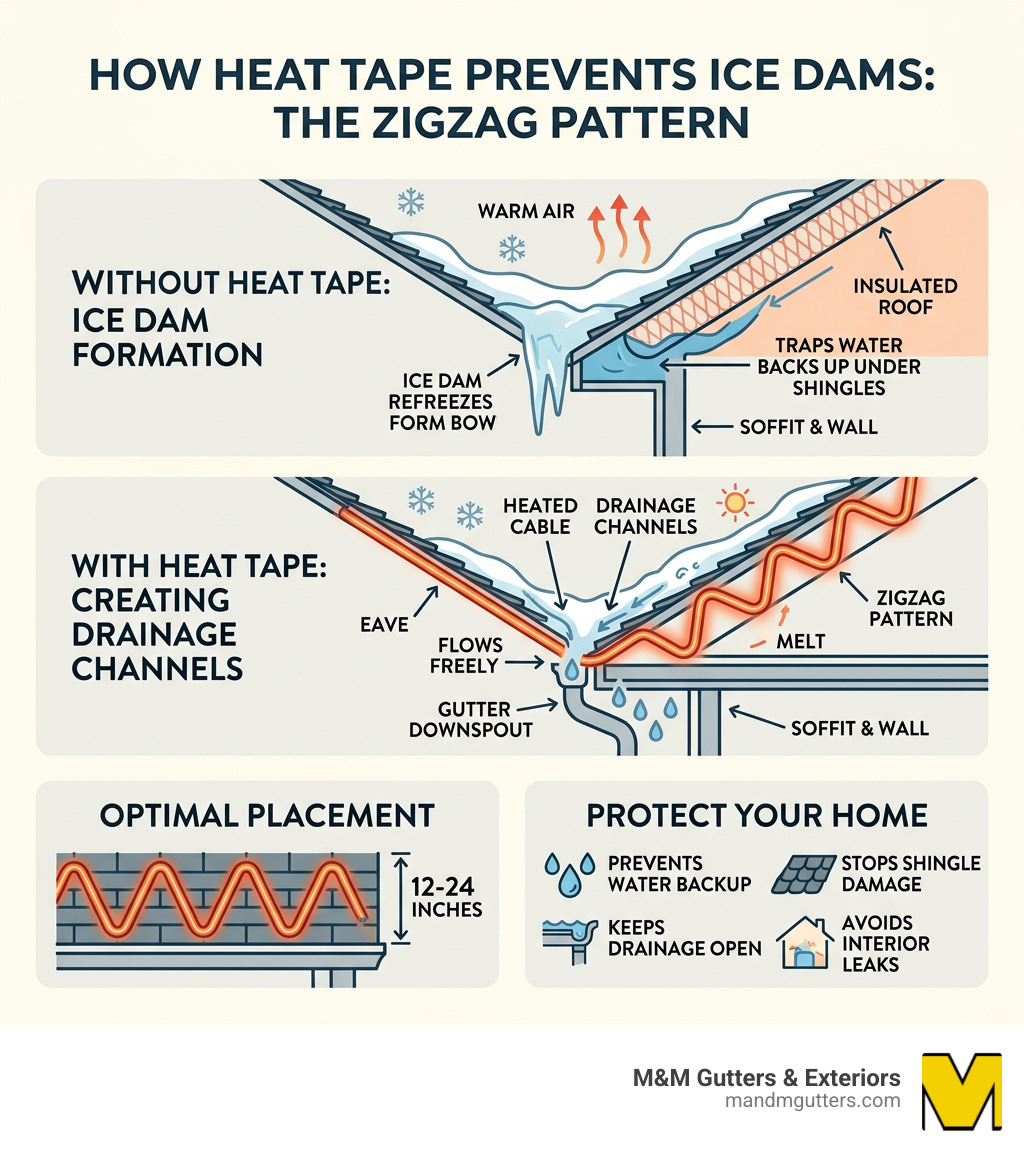
Every winter, ice dams quietly do serious damage to Utah homes. Snow melts on your warm roof, runs down to the cold eave, and refreezes. That frozen wall traps more water, which backs up under your shingles and into your home. The results? Leaks, rotted wood, ruined insulation, and gutters ripped clean off the fascia.
It’s a problem that catches a lot of homeowners off guard — until they see the water stain on their ceiling.
I’m Nathan Nuttall from M&M Gutters & Exteriors, and after more than 30 years helping Utah homeowners protect their roofs and gutters, I’ve seen how proper heat tape for roofs installation stops ice dam damage before it starts. In this guide, I’ll walk you through everything you need to know to get it done right.
Understanding Your Options for Heat Tape for Roofs Installation
Before you climb a ladder, you need to know what you’re putting on your roof. Not all heat cables are created equal. In the industry, we generally categorize these systems into two main types: self-regulating cables and constant wattage cables.
Self-Regulating Cables: The Smart Choice
For most residential applications in Salt Lake County and across Northern Utah, we highly recommend self-regulating heat cables. These are “smart” cables. They consist of a conductive core that adjusts its heat output based on the surrounding temperature. When it’s freezing, the cable works harder; when the sun comes out and warms the roof, the cable throttles back its energy consumption.
The biggest advantage here is safety and efficiency. Because they self-regulate, these cables won’t overheat if they happen to overlap—a common mistake in DIY heat tape for roofs installation. They typically produce about 6 to 8 watts per foot at freezing temperatures, providing enough “oomph” to melt channels through heavy Wasatch snow without wasting power.
Constant Wattage Cables: The Budget Alternative
Constant wattage cables are exactly what they sound like: they stay at one temperature the entire time they are plugged in. While they are often more affordable at big-box retailers, they require a bit more babysitting. You cannot overlap these cables, as they can create “hot spots” that might damage your shingles or even start a fire. They are less energy-efficient because they don’t “turn down” when the weather improves; they are either 100% on or 100% off.
Comparing the Two
| Feature | Self-Regulating Cable | Constant Wattage Cable |
|---|---|---|
| Energy Efficiency | High (adjusts to temp) | Low (always same output) |
| Safety | High (can overlap) | Moderate (cannot overlap) |
| Lifespan | Typically longer | Shorter |
| Upfront Cost | Higher | Lower |
| Installation | Easier (can be cut to length) | Fixed lengths only |
Most professional-grade systems we use at M&M Gutters & Exteriors range from 5 to 12 watts per foot. In our severe Utah climate, having that higher wattage capability ensures that even during a “lake effect” blizzard, your drainage paths stay open. Learn more about what an ice melting system is to see how these components fit into a larger home protection strategy.
Planning and Measuring for Success
The most common mistake we see in heat tape for roofs installation happens before a single clip is attached: buying the wrong length of cable. If the cable is too short, you leave gaps where ice dams will form. If it’s too long, you’re left with a dangerous coil of hot wire that has nowhere to go.
The “Think Like Water” Strategy
When planning your layout, you have to think like a raindrop. Your goal isn’t to melt all the snow on the roof—that would be incredibly expensive. Your goal is to create a clear, heated path from the roof surface, into the gutter, and down the downspout to the ground. If that path is broken at any point, the water will refreeze and the dam will return.
How to Calculate Your Cable Length
To get an accurate measurement, you need to break your roof down into sections:
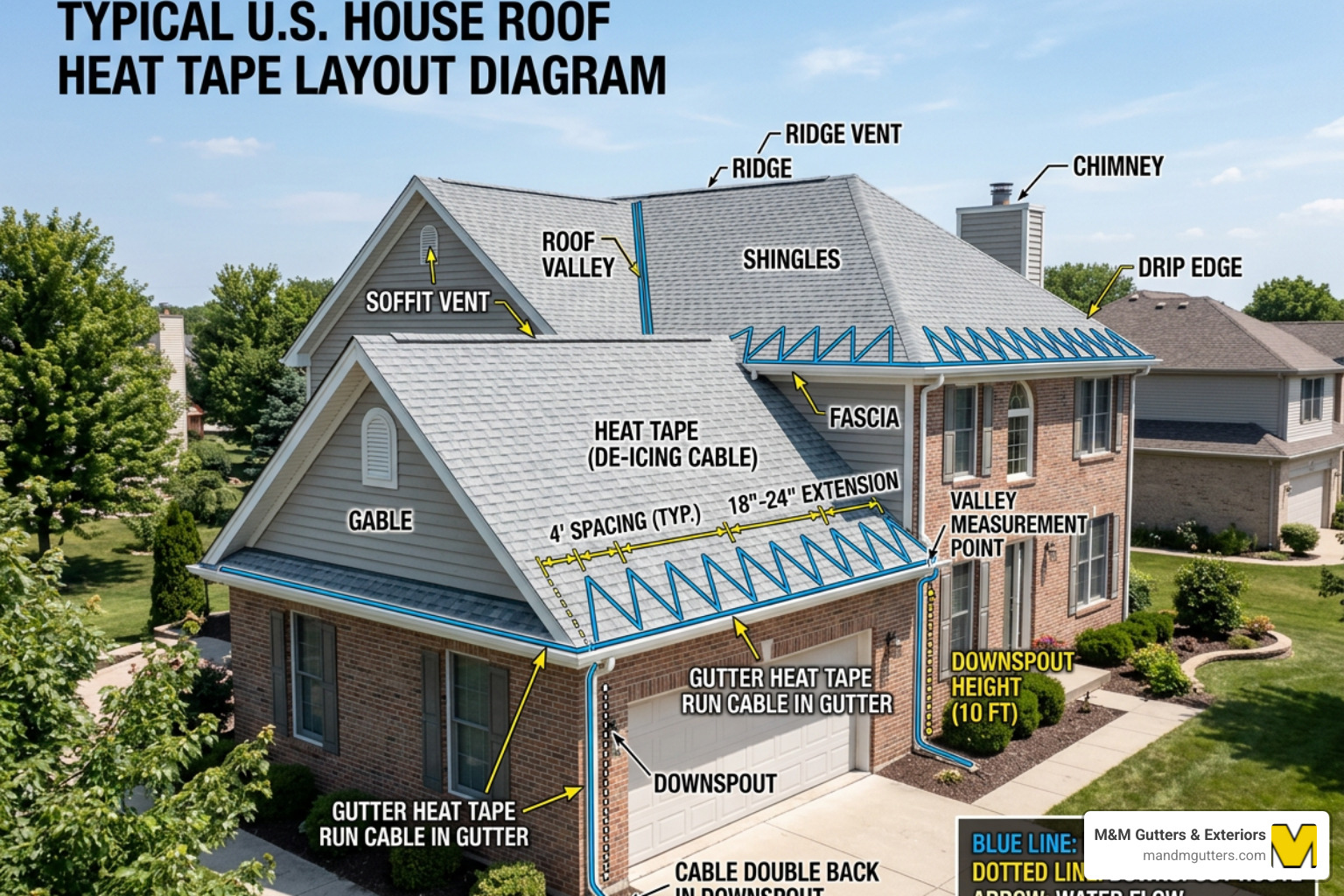
- The Eave Zigzag: Measure the total linear feet of the roof edge you want to protect. You’ll need to multiply this by a “zigzag factor” based on your roof’s overhang. For an 18-inch overhang, the factor is usually around 2.4. This accounts for the cable going up and down in triangles.
- The Gutters: Measure the total length of the gutters. The cable usually runs in a straight line along the bottom of the gutter.
- The Downspouts: This is where many DIYers fail. You need to run the cable down the downspout and back up (or at least to the bottom) to ensure the exit point doesn’t freeze shut. Measure the height of your downspouts and double it.
- The Valleys: If you have valleys (where two roof sections meet), ice accumulates there heavily. Plan to run the cable about 3 to 4 feet up into each valley.
The Golden Rule of Measuring: Once you have your total, add a 10-15% buffer. This “length buffer” covers the extra cable needed for transitions, wrapping around gutter hangers, and reaching your power source. It’s much easier to hide a few extra feet in a gutter than it is to stretch a cable that’s six inches too short.
By taking these precise measurements, you ensure your system is optimized for the unique layout of your home. How to prevent ice dams on your roof often starts with this kind of meticulous planning.
The Step-by-Step Installation Process
Once you have your materials, it’s time for the actual heat tape for roofs installation. We always tell our clients in Davis and Weber counties: wait for a dry day. Trying to install electrical components on a slippery, wet roof is a recipe for disaster.
Preparation and Safety
First, clean your gutters. Any leaves, needles, or debris left in the gutter can catch fire if they come into contact with a high-wattage cable, or at the very least, they will trap moisture and cause the cable to work harder than necessary.
Safety gear is non-negotiable. Use a sturdy extension ladder, wear slip-resistant shoes, and use a roof harness if you’re working on a steep pitch. If you have any hesitation about heights, this is the perfect time to call in the pros. Steps and considerations for installing roof heat tape include prioritizing your physical safety above all else.
Perfecting the Zigzag Pattern for Heat Tape for Roofs Installation
The zigzag (or sine wave) pattern is the “engine” of your de-icing system. It creates those vital triangular tunnels through the snow.
- Triangle Height: Your zigzag should extend from the eave up to about 6 inches past the “warm zone” of your roof (the part of the roof that sits over the heated interior of your house). Typically, this means the triangles are 12-24 inches high.
- Triangle Width: We generally space the peaks of the triangles about 15 inches apart.
- Clip Spacing: Use specialized shingle clips to secure the cable at each peak and valley of the zigzag. Space your clips every 18-24 inches along the eave to keep the cable from sagging. Never use staples or nails, as piercing the cable’s jacket will cause a short circuit or a fire.
Required Tools List:
- Self-regulating heat cable
- UV-stabilized shingle clips
- Gutter clips/hangers
- Measuring tape and chalk (for marking patterns)
- Sturdy ladder
- Work gloves and safety goggles
Properly installed triangles ensure that meltwater always has a path to the gutter. Without this pattern, you’re just moving the ice dam higher up the roof. Understanding the dangers of icicles to people and property is a great reminder of why we do this work—it’s not just about the roof; it’s about protecting the people walking below it.
Securing Cables in Gutters and Downspouts
Once the roof edge is done, the cable must drop into the gutter. Don’t let it just dangle; use gutter clips to keep it suspended near the bottom where the water flows.
For downspouts, use the “down-and-back-up” method. This ensures that even if the downspout is packed with slush, the heat cable creates a vertical chimney of melted space, allowing water to escape. If you just run it down once, the cable might get surrounded by ice and become ineffective.
Gutter Maintenance Tips:
- Check that the cable is resting on the gutter bottom, not floating on top of debris.
- Ensure the cable doesn’t touch sharp gutter edges; use “drip loop” protectors if necessary.
- Confirm that the cable extends all the way to the end of the downspout exit.
Why you should invest in an ice melting system becomes clear during the first big February thaw when your neighbors have two-foot icicles and your gutters are running clear.
Electrical Safety and System Testing
You can have the most beautiful zigzag pattern in Utah, but if the electrical connection isn’t right, the system is useless—or worse, dangerous.
Power Requirements
Most residential systems run on 120V, but larger homes or commercial properties might require 240V. Regardless of the voltage, your heat tape for roofs installation must be connected to a GFCI (Ground Fault Circuit Interrupter) or GFEP (Ground Fault Equipment Protection) outlet. Standard outlets aren’t enough; you need that safety trip to prevent electrical fires if the cable jacket gets damaged by a squirrel or a falling branch.
Controlling the Heat
Don’t just plug it in and leave it all winter. That’s a great way to send your Rocky Mountain Power bill into the stratosphere.
- Manual Switches: The simplest option, but you have to remember to flip it.
- Thermostats: These turn the system on when the temperature drops below a certain point (usually 40°F).
- Moisture Sensors: The gold standard. These only activate the system if it’s cold and there is moisture present. This is the most energy-efficient tip for heat tape usage because it prevents the cables from running on dry, sunny, 20-degree days.
Final Testing of Your Heat Tape for Roofs Installation
Never assume it works just because it’s plugged in.
- Visual Inspection: Walk the perimeter. Ensure no clips have popped off and the cable hasn’t shifted.
- Power-On Test: Plug it in for 10-15 minutes. Feel the cable (carefully!); it should be warm to the touch, not scalding. Some professional cables even have “GlowCap” LEDs that light up to show they are receiving power.
- Insulation Resistance Test: For the ultimate peace of mind, use a megohmmeter. This device tests the integrity of the cable’s insulation. We look for a reading of at least 30 megohms. If it’s lower, there’s a leak in the electrical jacket that could cause a short later in the season.
If this sounds like a lot of technical work, you’re right. Roof heat cable installation: DIY vs. hiring a pro is a choice every homeowner has to make. While DIY is possible for the handy, the electrical and height risks lead many to choose professional installation.
Frequently Asked Questions about Roof Heat Tape
When should I turn on my roof heat tape?
You should turn your heat tape on before the snow starts falling. We recommend the “40°F rule”—activate the system when the forecast calls for precipitation and temperatures are dropping toward freezing. If you wait until an ice dam has already formed, the cable has to work ten times harder to melt through the solid ice. It’s much more efficient to prevent the ice from bonding to the roof in the first place.
Can I install heat tape on a metal roof?
Yes, but the process is different. You can’t use shingle clips on a metal roof. Instead, we use specialized adhesive-backed clips or standing seam clamps. We often install the cable in a “sine wave” pattern on metal roofs. Also, because snow tends to slide off metal roofs in large sheets (avalanching), you must have snow blocks or snow guards installed above the heat tape. Otherwise, the first big snow slide will rip your expensive heat cables right off the roof.
How much does it cost to run heat tape?
Operating costs depend on the length of the cable and your local electricity rates. A typical 100-foot cable drawing 7 watts per foot uses 700 watts of power. If you run that for 24 hours at a rate of $0.12 per kWh, it costs about $2.00 per day. By using a moisture sensor or thermostat, you can ensure the system only runs when necessary, keeping your seasonal costs manageable while protecting your home from thousands of dollars in water damage.
Conclusion
Heat tape for roofs installation is one of the smartest investments you can make for your Northern Utah home. From the steep peaks of Summit County to the valleys of Tooele, our winters don’t play fair. A properly planned, measured, and installed heat cable system is your best defense against the destructive power of ice dams.
At M&M Gutters & Exteriors, we bring over 30 years of experience to every job. We don’t just “string some wire”—we design a comprehensive drainage solution tailored to your home’s specific needs. Whether you need a simple eave system or a complex setup with moisture sensors and 3D visualization, we have the tools and the expertise to get it done right.
Don’t wait for the first leak to appear this winter. Schedule your professional roof heat cable installation with M&M Gutters & Exteriors today and enjoy the peace of mind that comes with a protected home.