


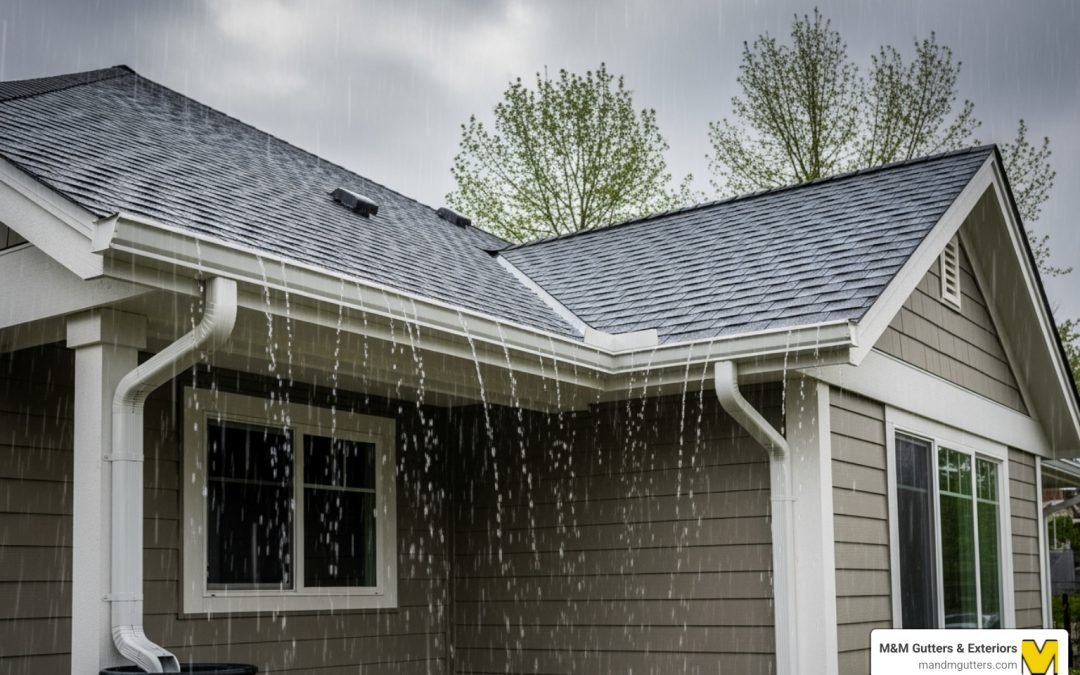
What Is a PVC Rain Water Gutter and Why Does It Matter?
A pvc rain water gutter is a channel made from high-impact polyvinyl chloride (PVC) that runs along your roofline to collect rainwater and direct it safely away from your home’s foundation.
Quick answer: Here’s what you need to know at a glance:
| Feature | Detail |
|---|---|
| Material | High-impact PVC (polyvinyl chloride) |
| Purpose | Collects roof runoff and channels it to downpipes |
| Lifespan | 30-50 years under normal conditions |
| Key benefit | Corrosion-proof, lightweight, and low-maintenance |
| Common sizes | 112mm (residential) to 170mm+ (commercial) |
| Profiles available | Half-round, K-style, square, deep flow |
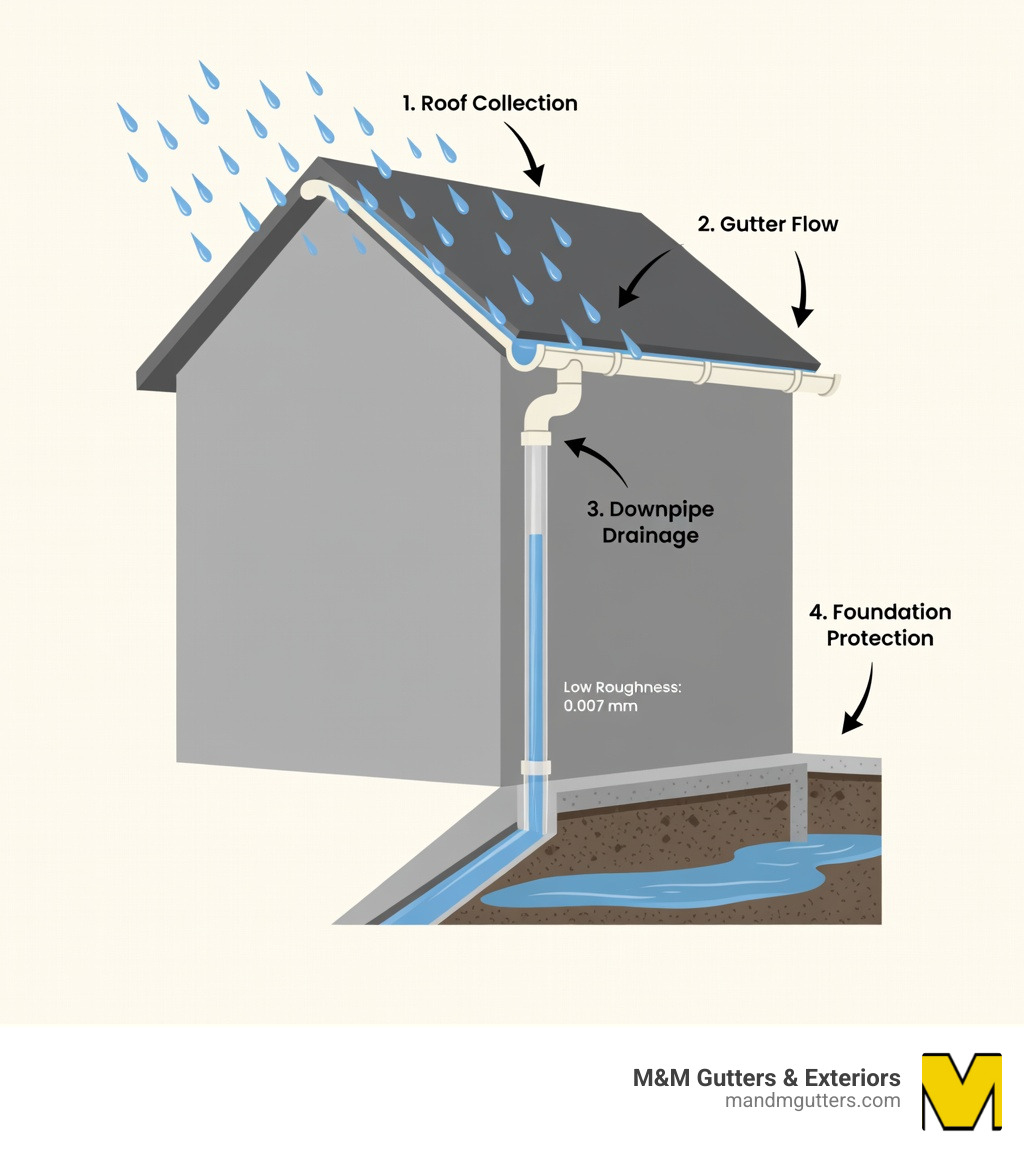
Without gutters, rainwater falls directly off your roof edge. That sounds harmless — but over time it causes serious problems. Soil erodes. Foundations crack. Basements flood. Roof shingles get damaged from water pooling at the eaves.
PVC gutters solve this by creating a smooth, sealed path for water to travel — from your roof, through the downpipe, and away from your home.
They’re one of the most popular gutter choices for homeowners today, and for good reason. PVC has the lowest roughness coefficient of any gutter material — just 0.007 mm — meaning water flows through it more easily than metal, wood, or any other option. That smoothness also helps prevent debris from sticking and clogging the system.
I’m Nathan Nuttall from M&M Gutters & Exteriors, and after more than 30 years helping Utah homeowners choose and install the right pvc rain water gutter systems, I’ve seen what works — and what fails. In this guide, I’ll walk you through everything you need to know to protect your home the right way.
Terms related to pvc rain water gutter:
Understanding the PVC Rain Water Gutter System
When we talk about a pvc rain water gutter system, we aren’t just talking about a plastic trough. It is a highly engineered drainage network designed to handle thousands of gallons of water during a typical Utah storm. These systems are manufactured from high-impact PVC that is colored throughout the material. This means if a stray branch scratches the surface, the color remains consistent rather than showing a metallic silver or white base underneath.
The primary function of the system is simple: catch water at the eaves and move it to the downpipes. However, the science behind it is fascinating. Because PVC has a roughness coefficient of only 0.007 mm—the lowest of any gutter material—water moves with incredible velocity. This “slickness” creates a self-cleaning effect where the water carries away small silt and debris that might settle in rougher metal gutters.
For homeowners looking at a rain gutter materials guide, the choice often comes down to performance in specific climates. In our experience across Salt Lake City and Northern Utah, PVC is particularly valued for its flexibility. It doesn’t dent from ladders or light hail, and it won’t rust if water sits in it for extended periods.
Essential Components of a PVC Rain Water Gutter
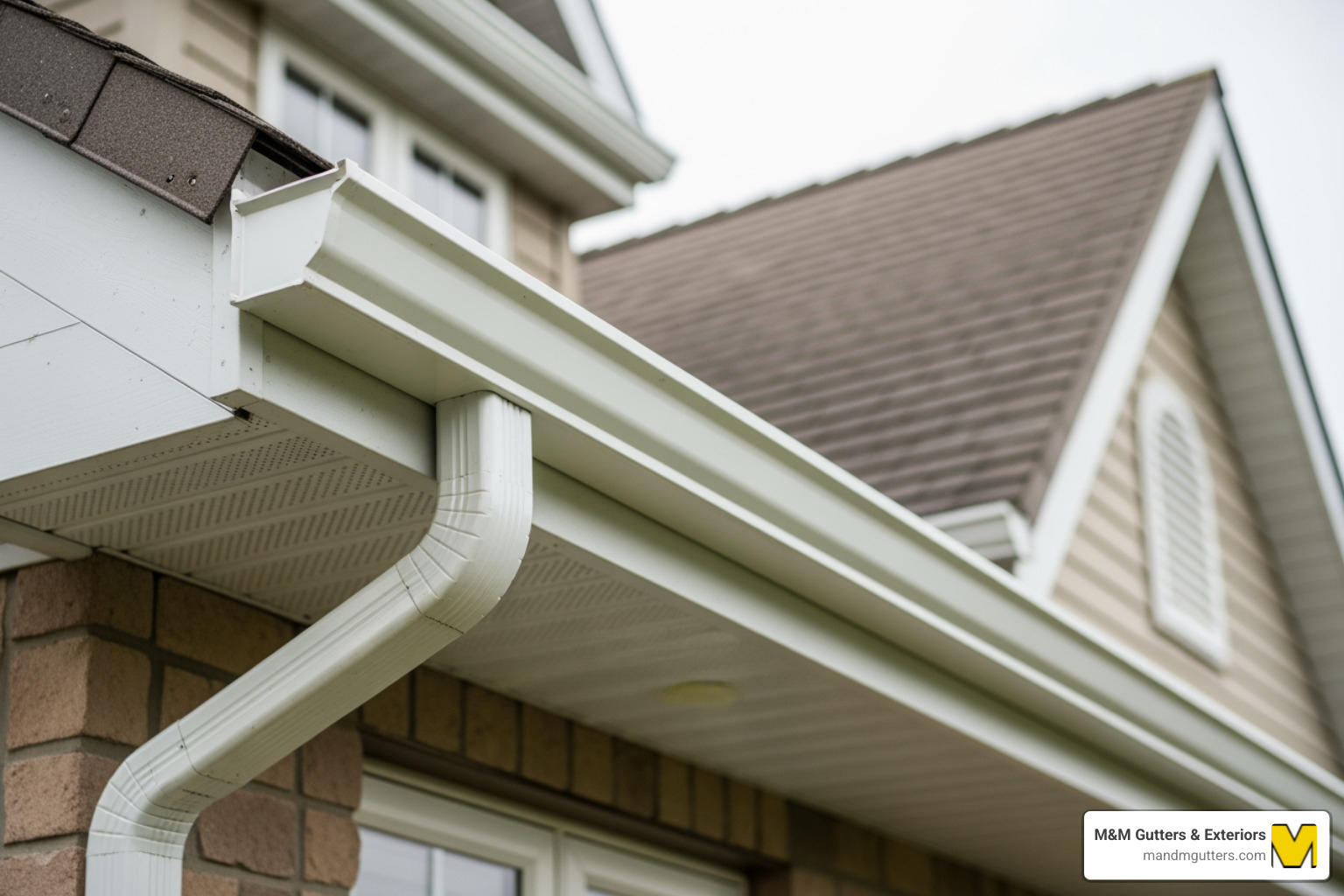
A complete system is like a giant Lego set. Each piece has a specific job to ensure the water stays inside the channels. Here are the parts we use to build a professional-grade system:
- Gutter Sections: The main horizontal runs, often available in 10ft or 20ft lengths.
- Running Outlets: These are the “drop points” where the horizontal gutter connects to the vertical downpipe.
- Union Brackets: These join two lengths of gutter together, often featuring rubber seals to prevent leaks.
- Stop Ends: Caps that close off the end of a gutter run.
- Fascia Brackets: The “skeleton” of the system that holds the gutters to your home’s eaves.
- Downpipe Clips: Brackets that secure the vertical pipes to your siding or brick.
- 75-Degree Elbows: Used to navigate the overhang of your roof (the soffit) to get the downpipe flush against the wall.
- PVC Cement or Lubricant: Depending on the brand, components are either chemically welded together with cement or snapped together using silicone lubricant and “captive seals.”
Understanding these parts is the first step in recognizing the different types of rain gutters and how they are assembled for maximum durability.
Material Properties and Performance
Modern pvc rain water gutter systems are a far cry from the “plastic” gutters of the 1970s. Today’s formulations are UV-stabilized, meaning they contain special inhibitors that protect the plastic from becoming brittle under the intense high-altitude sun we get in the Wasatch Front.
Furthermore, these systems are lead-free, making them safer for the environment and fully recyclable at the end of their long life. They are incredibly lightweight—a 4-meter (approx. 13ft) section of standard 112mm gutter weighs only about 2.3 kg (5 lbs). This low weight reduces the physical stress on your fascia boards compared to heavy wood or thick steel gutters. If you are researching what types of rain gutters are there, you’ll find that PVC’s combination of impact strength and corrosion resistance makes it a top contender for modern residential builds.
Advantages and Limitations of PVC Gutters
Every material has its trade-offs. While we love the versatility of PVC, it’s important to understand where it shines and where it needs a little extra care during installation.
| Feature | PVC (Vinyl) Gutters | Aluminum Gutters |
|---|---|---|
| Rust Resistance | 100% Rust-proof | Rust-resistant (can corrode over time) |
| Impact Resistance | High (bounces back from dents) | Low (dents easily) |
| Installation | Easy (Snap-together/DIY friendly) | Moderate (Requires specialized tools) |
| Thermal Expansion | High (Expands/contracts significantly) | Low (Very stable) |
| Color Variety | Good (Mass-colored) | Excellent (Painted/Coated) |
| Maintenance | Very Low | Low |
Why Homeowners Choose Vinyl
The biggest draw for a pvc rain water gutter is its “set it and forget it” nature. Because the color is baked into the material, you never have to worry about paint peeling or scratching. If a ladder bumps it, the PVC flexes and returns to its original shape, whereas aluminum would be left with a permanent dent.
This durability makes it a great choice for homeowners who want to match their gutters to their siding or trim without the fear of future maintenance. When deciding vinyl vs aluminum gutters which one is best, many of our customers in Davis and Weber counties choose vinyl for its cost-effectiveness and ease of cleaning. It’s a fantastic way to get a high-end look on a budget, especially when you consider which kind of rain gutter is best for you and your home based on local weather patterns.
Challenges with PVC Rain Water Gutter Systems
The primary “enemy” of a PVC system is temperature change. PVC has a high coefficient of thermal expansion. To put that in perspective, a 10-meter (33ft) run of gutter can expand or contract by as much as 16 mm (over half an inch) with a temperature swing of just 20°C (36°F). In Utah, where we can see a 40-degree difference between a sunny afternoon and a freezing night, this is a huge factor.
If the installer doesn’t leave proper expansion gaps in the fittings, the gutters can “snake,” buckle, or pull away from the brackets. Additionally, while UV stabilizers have improved, lower-quality PVC can fade over decades of exposure. When looking at what is the average cost of rain gutters, the cheapest option might lack the necessary UV protection or wall thickness (standard high-quality PVC gutters should be about 2.2mm thick).
Sizing and Profiles for Your Home
Not all roofs are created equal. A small cottage in Tooele doesn’t need the same gutter capacity as a sprawling commercial warehouse in Salt Lake City. Choosing the right profile is about both aesthetics and physics.
- Half-Round: A classic “U” shape that looks great on traditional or historic homes. Its smooth curves are excellent for water flow.
- K-Style (Ogee): Mimics the look of crown molding. It’s the most common residential profile in the US and holds more water than a half-round of the same width.
- Square/Corniche: Often used on modern homes or commercial buildings for a clean, angular look.
- Deep Flow/Elliptical: These have a deeper profile than standard gutters, designed specifically for areas with high rainfall intensity or very large roof slopes.
Finding the right style is part of the fun—it’s like a local gutter treasure hunt finding pvc vinyl 20ft gutters and more to perfectly match your home’s architecture.
Calculating Capacity and Roof Area
To ensure your pvc rain water gutter doesn’t overflow during a summer downpour, we calculate the Effective Roof Area (ERA). This isn’t just the flat square footage of your roof; it accounts for the pitch (steepness). The steeper the roof, the more rain it “catches” during wind-driven storms.
The formula we often use is: ERA = (W + H/2) x L (Where W is horizontal width, H is vertical rise, and L is the length of the gutter run).
In the UK and parts of the US, systems are often designed to handle a rainfall intensity of 75mm per hour. This is the “gold standard” for safety. For more technical details on flow rates, you can consult the Rainwater Technical Manual, which explains how a single 68mm downpipe can drain a roof area of up to 122 square meters at a flow rate of 2.54 liters per second.
Selecting the Right PVC Rain Water Gutter Size
For most homes in Salt Lake County, a 112mm (approx. 4.5 inch) half-round or a 5-inch K-style system is the standard. However, if you have a particularly large roof or live in an area prone to flash flooding, you might step up to a “SuperDeep” 170mm system.
- 112mm Standard: Best for average residential homes.
- 125mm Surefit: A high-capacity residential option that can handle up to 4.9 liters of water per second—perfect for larger Utah homes.
- 170mm SuperDeep: Designed for commercial buildings, hotels, or flats with massive roof areas.
- Downpipe Sizing: Pair your gutters with the right pipes. A 68mm round pipe is standard, but switching to an 82mm pipe can significantly increase the volume of water the system can move.
Installation and Maintenance Best Practices
Installation is where the “rubber meets the road”—literally. If a pvc rain water gutter isn’t installed with the right “fall” (slope), water will pool, mosquitoes will breed, and the system will eventually fail.
Proper Fixing and Jointing Methods
At M&M Gutters & Exteriors, we follow strict guidelines to ensure your system lasts for decades. Here is the professional approach to installation:
- The Fall Gradient: Gutters should never be perfectly level. We aim for a fall of roughly 1:350 (about 1 inch of drop for every 30 feet of gutter). This ensures gravity does the work.
- Bracket Spacing: We place fascia brackets at a maximum of 24-inch (60cm) centers. In areas of Northern Utah that get heavy snow, we tighten that spacing to 16 or 18 inches to handle the “snow load” weight.
- Expansion Gaps: This is the most common DIY mistake. You must leave a gap (usually about 11mm) at each joint to allow the plastic to grow and shrink. Most professional PVC fittings have “sight holes” or “insertion marks” to show you exactly where to stop the pipe.
- Deburring: Every time a pipe is cut, the edges must be smoothed (deburred) so they don’t catch hair, leaves, or debris.
- Lubrication: We use silicone lubricant on the rubber seals. This doesn’t just stop leaks; it allows the gutter to slide smoothly during thermal expansion without making a “creaking” noise.
If you’re not comfortable on a ladder, our services rain gutters installation can take the stress off your hands.
Long-term Maintenance and Longevity
While PVC is low-maintenance, it isn’t “no-maintenance.” To get the full 30-50 year lifespan out of your system, you should:
- Clean Twice a Year: Spring and Fall are the best times to remove leaves and twigs.
- Inspect the Seals: Check the union brackets for any signs of “drip marks” which indicate a seal might have shifted.
- Check the Brackets: Ensure all screws are tight, especially after a heavy snow season in Summit County.
- Install Gutter Guards: If you live in a wooded area, micro-mesh or plastic screens can save you hours of cleaning. Just be aware that cheap plastic screens might only last 3-6 years, while professional-grade guards can last 20.
Frequently Asked Questions about PVC Gutters
How long do PVC gutters typically last?
Under normal conditions, a high-quality pvc rain water gutter system will last between 30 and 50 years. The main factors that reduce this lifespan are extreme physical impact (like a falling tree limb) or improper installation that doesn’t account for thermal expansion.
Are PVC gutters better than aluminum in cold climates?
PVC is excellent in cold, snowy areas because it is 100% water-resistant—it won’t rust or corrode from road salt or standing snow. However, it can become more brittle in extreme sub-zero temperatures. High-impact PVC is designed to withstand this, but it’s why we emphasize professional installation to avoid stress points.
Can I install PVC gutters myself?
Yes! One of the biggest advantages of PVC is that it is very DIY-friendly. Most systems use a “snap-fit” design that requires no specialized tools other than a hacksaw and a drill. However, getting the slope (fall) and expansion gaps correct is tricky. If you have a multi-story home or a complex roofline, it’s usually safer and more effective to call the pros.
Conclusion
A pvc rain water gutter is more than just a home accessory; it is a vital shield for your home’s foundation and roof. With its incredible smoothness, rust-proof nature, and low maintenance requirements, it is a smart investment for any Utah homeowner.
At M&M Gutters & Exteriors, we bring over 30 years of experience to every project across Salt Lake City, Utah County, and the surrounding areas. We don’t just guess where your gutters should go—we use advanced 3D visualization through HOVER to show you exactly how your new system will look and perform before we ever turn a screw.
Whether you are looking for a classic half-round look or a high-capacity commercial system, we are here to help. Ready to keep your home dry for the next 50 years? Contact us today for a professional services rain gutters installation and let us help you protect your biggest investment.