


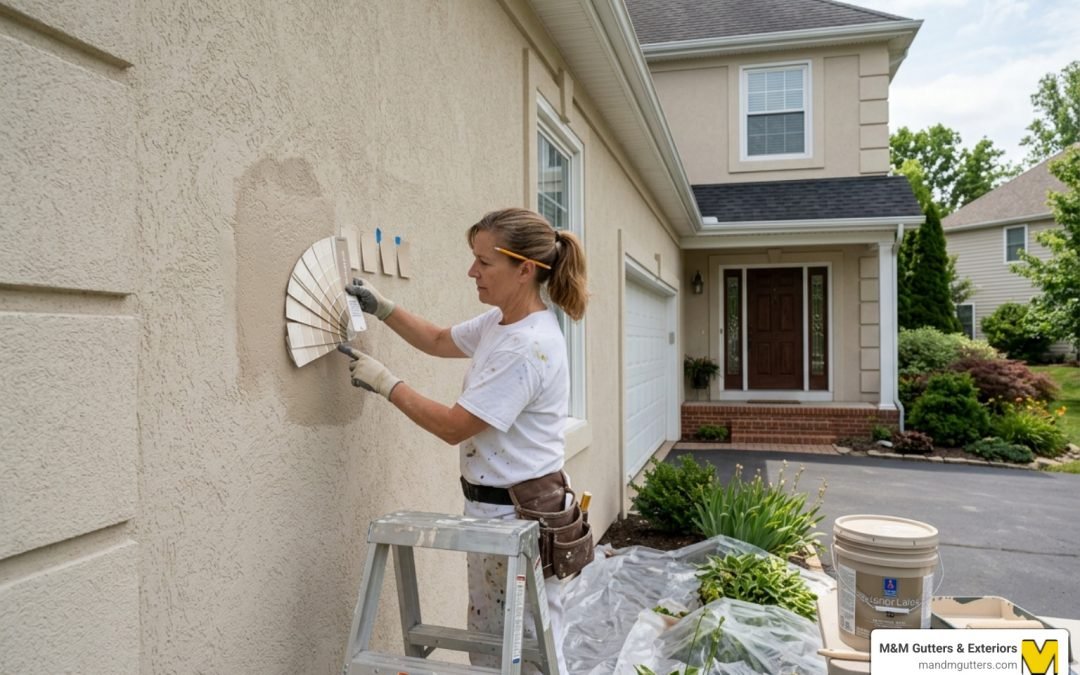
Why Getting Stucco Siding Paint Matching Right Matters for Your Home
Stucco siding paint matching is the process of identifying and applying a paint or finish color that blends seamlessly with your existing stucco exterior. Here’s a quick summary of how it works:
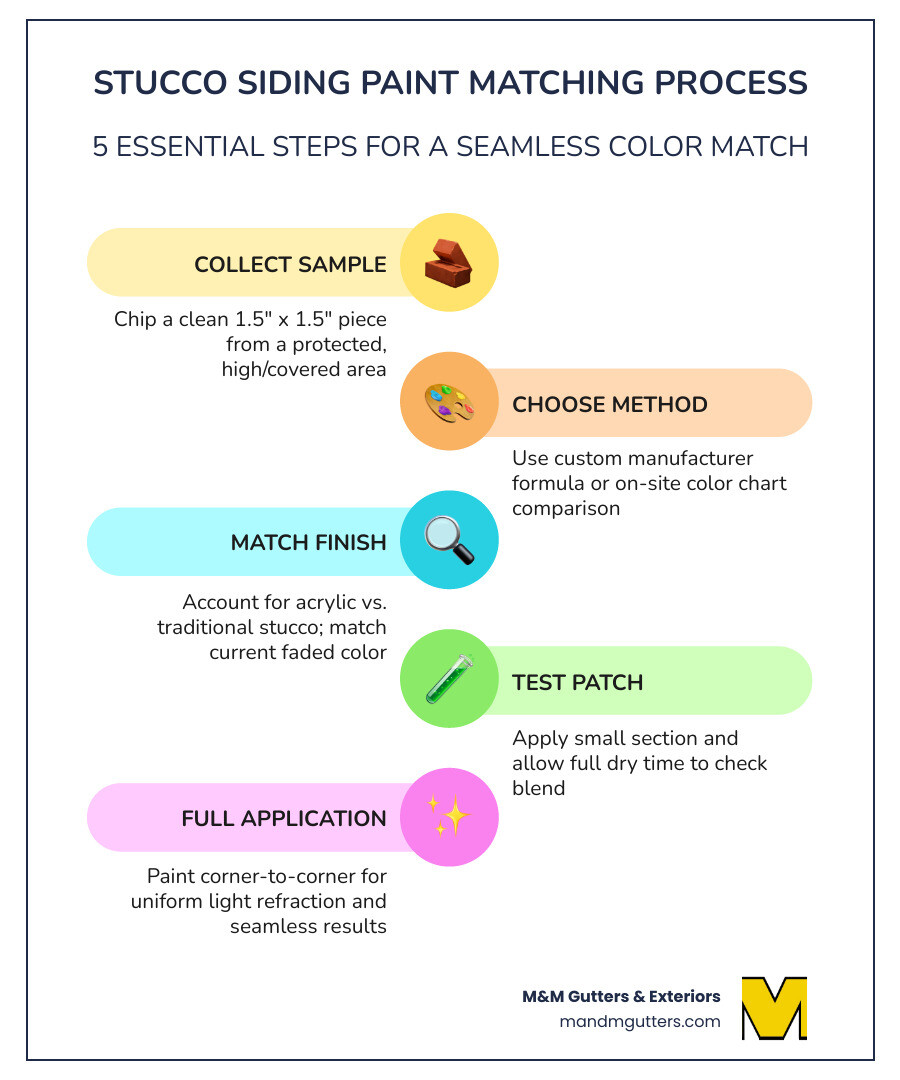
- Collect a clean sample – Chip a 1.5″ x 1.5″ piece from a protected area of your wall
- Choose your method – Custom manufacturer match or compare color chart swatches on-site
- Know your finish type – Acrylic stucco is easier to match; traditional cement stucco is harder
- Account for fading – You’re matching the current color, not the original
- Test before committing – Apply a small patch and let it dry completely before painting a full wall
Getting this wrong is more common than you’d think. Stucco fades unevenly across different sides of a house. UV exposure, decades of weathering, and changing pigment availability from manufacturers all make an exact match difficult. One homeowner described bringing a stucco chip to a big-box store for a computer match — only to find the result was “not even in the ballpark.”
The stakes are real. A mismatched repair stands out like a sore thumb, hurting curb appeal and resale value. And in Utah’s climate — with intense UV exposure, freezing winters, and dry summers — stucco takes a beating that accelerates color drift faster than in milder regions.
This guide walks you through every step of the process, from pulling a sample to choosing the right paint product for a result that actually blends.
I’m Nathan Nuttall from M&M Gutters & Exteriors — after 30+ years helping Utah homeowners tackle exterior projects, stucco siding paint matching is one of the most common (and most misunderstood) challenges I see. Whether you’re patching a small repair or refreshing an entire wall, the steps in this guide will help you avoid the most costly mistakes.
Why Stucco Siding Paint Matching is a Unique Challenge
When we talk about stucco siding paint matching, we aren’t just talking about picking a pretty color from a fan deck. Stucco is a living, breathing material — figuratively speaking. Because it is highly porous, it interacts with the environment in ways that vinyl or wood siding simply don’t.
The UV and Porosity Problem
In Salt Lake City and throughout Northern Utah, our homes are exposed to intense high-altitude UV rays. Over 20 or 40 years, the sun literally “eats” the pigments in your stucco. This fading doesn’t happen evenly; the south-facing side of your home will likely be several shades lighter than the north-facing side. When you attempt stucco siding paint matching, you aren’t matching the color the builder applied in 1985; you’re matching the faded, weathered version of that color.
Furthermore, stucco’s porosity is a double-edged sword. While it allows the home to “breathe,” it also absorbs dust, pollutants, and minerals from rain. Traditional cement-based stucco is particularly notorious for this. These microscopic particles change the “read” of the color, making it look grittier or darker than a clean paint chip.
Technical Performance and pH Levels
Stucco is alkaline. New stucco can have a pH level as high as 13. If you apply a standard exterior paint too soon or use the wrong product, the alkalinity will burn through the paint, causing it to peel or discolor within months. This is why we recommend products like high-build acrylic finishes that are specifically designed to handle high pH environments.
Additionally, the texture of stucco creates “micro-shadows.” A computer scanner at a paint store works best on flat, smooth surfaces. When it tries to read a rough “dash” or “lace” stucco finish, those tiny shadows confuse the sensor, leading to that “not even in the ballpark” result we mentioned earlier.
If your stucco is starting to show its age beyond just the color, it’s worth checking out our guide on 5 Signs It’s Time to Replace Your Siding to see if a simple paint match is enough or if a larger intervention is needed.
Traditional vs. Acrylic Finishes
There is a massive difference between matching traditional (cement-based) stucco and modern acrylic (synthetic) finishes.
- Traditional Stucco: Hardest to match. It is essentially a colored concrete. The color is often inconsistent across the wall and changes based on how much water was used during the original mix.
- Acrylic Finishes: These are essentially high-performance “paints” with sand mixed in. They are much more consistent and easier to match because the pigments are more stable.
Step-by-Step Guide to Successful Stucco Siding Paint Matching
Achieving a seamless blend requires a methodical approach. We’ve seen many DIY attempts fail because the homeowner rushed the sampling phase.
1. Sample Collection: The 1.5″ x 1.5″ Rule
To get a custom match, you need a physical piece of the house. We recommend chipping off a piece roughly 1.5 inches square.
- Where to look: Don’t just grab a piece from the middle of the front wall. If you are doing a repair, take the sample from the area immediately adjacent to the repair.
- Hidden gems: If you’re worried about leaving a hole, look behind downspouts, under the eaves, or in areas where a previous renovation might have left a loose piece of “demo” stucco.
- Cleanliness matters: Scrub the sample gently with a soft brush and water to remove surface dirt before taking it to the store. You want to match the color, not the Salt Lake City dust!
2. The Comparison Table: Traditional vs. Acrylic
When you go to the supplier, you need to know what you’re asking for.
| Feature | Traditional Stucco | Acrylic Finish |
|---|---|---|
| Composition | Cement, Lime, Sand, Pigment | 100% Acrylic Polymers, Sand |
| Matching Ease | Difficult (Inconsistent) | Easier (Consistent) |
| Best Match Tool | Physical color charts & on-site tinting | Computer scan & manufacturer formulas |
| Texture | Usually rougher/varied | More uniform |
3. On-Site Testing and Light Refraction
Never buy five gallons of paint based on a tiny swatch you looked at inside a fluorescent-lit store. Light refraction on stucco is tricky. We always suggest buying a small “Color to Go” sample first.
- Apply a 2′ x 2′ patch on the wall you intend to match.
- Wait 24 hours. Paint dries darker on stucco than it looks in the bucket.
- Observe the patch in the morning, noon, and evening. The Utah sun will make colors look vastly different at 8:00 AM than they do at 6:00 PM.
For those in the Salt Lake area looking for professional help with these textures, we offer specialized Stucco & Stone Siding in Salt Lake City to ensure the finish and color are handled by experts.
Obtaining a Custom Color Match for Stucco
If you are working with a manufacturer like Sherwin-Williams or Benjamin Moore, they have massive databases (sometimes over 3,000 results for “stucco”) to help you find a starting point. However, if your home is 20+ years old, the original pigments may have been discontinued or reformulated due to environmental regulations.
When we handle stucco siding paint matching for our clients, we often work with professional color consultants who understand how to manually adjust a formula. If the computer says “add two drops of black,” an expert might know that “one drop of deep umber” will actually match the aged Utah stucco better.
If you’re curious about how this fits into a larger home update, you can explore our full range of Exterior Siding Services.
Pro Tips for Stucco Siding Paint Matching on Faded Walls
If your stucco is 40+ years old, an “exact match” for a patch is almost impossible. Here is how the pros handle it:
- Match the Fade: Don’t try to find the “original” color. Match what is there now.
- Corner-to-Corner Painting: If you have a large repair, don’t just paint the patch. Paint the entire wall from one corner to the other. The slight color difference between the new wall and the old adjacent wall will be hidden by the natural shadow line at the corner.
- The “Flat” Rule: Always use a flat sheen for stucco. Semi-gloss or satin finishes will highlight every bump, crack, and imperfection in the stucco. A flat finish absorbs light, helping the new paint blend into the old texture.
- Sheen Matching: Even “flat” varies between brands. If you can’t match the brand, you might see a “halo” around your repair where the light reflects differently.
To keep your siding looking great for the long haul, check out our tips on 3 Ways to Extend the Life of Your Home’s Siding.
Choosing the Right Materials: Paint vs. Tinted Stucco
A common question we get is: “Should I use tinted stucco or just paint over it?”
Elastomeric Paint: The Heavyweight Champion
For older stucco that has developed fine hairline cracks (which is very common in the freeze-thaw cycles of the Wasatch Front), we often recommend Elastomeric paint.
- Longevity: It can last up to 20 years.
- Flexibility: It is a high-build coating that stretches. As your home expands in the summer heat and contracts in the winter, the paint moves with it, bridging cracks up to 1/16th of an inch.
- Weather Protection: These coatings are designed to withstand 98 mph wind-driven rain, meeting Federal Specification TT-C555B. This is vital for preventing water ingress that leads to costly internal damage.
Acrylic Topcoats
If your stucco is in great condition, a 100% acrylic exterior paint is a fantastic, breathable option. It’s more affordable than elastomeric and dries quickly, making it a popular choice for many homeowners.
Note: If you’re wondering about other siding types, like if you Can You Paint Vinyl Siding?, the rules are quite different, so make sure you’re using the right product for the right material!
Before you start, always review the Safety and data sheets for elastomeric masonry paint to ensure you are applying it under the right temperature conditions (usually between 35°F and 90°F).
Preparing Your Surface for a Seamless Blend
You could have the most perfect stucco siding paint matching formula in the world, but if you apply it to a dirty wall, it will fail.
1. Cleaning and Efflorescence Removal
Use a pressure washer to remove dirt and loose debris, but be careful! Stucco is softer than concrete. Too much pressure can “etch” the surface, changing the texture and ruining your color match. If you see white, powdery stains, that’s efflorescence — salt deposits caused by water moving through the masonry. You must find the source of the water (often a leaky gutter!) and clean the salts with a wire brush or a mild muriatic acid solution before painting.
2. Crack Repair and pH Testing
Fill any large cracks with a high-quality stucco patch or siliconized acrylic latex caulk. If you are applying a fresh coat of “color coat” stucco, remember it needs to cure for at least 30 days. Painting too early over fresh cement will lead to “alkali burn,” where the paint turns white or yellow.
3. Priming
For the best results, especially on older, chalky stucco, use a masonry primer. This seals the surface and provides a uniform “canvas” for your matched paint, ensuring the color looks the same across the entire repair.
Ignoring these steps can lead to disaster. We’ve outlined 5 Reasons to Fix Your Damaged Siding Right Away to help you understand the risks of putting off these essential repairs.
Frequently Asked Questions about Stucco Siding Paint Matching
How often should I repaint my stucco siding?
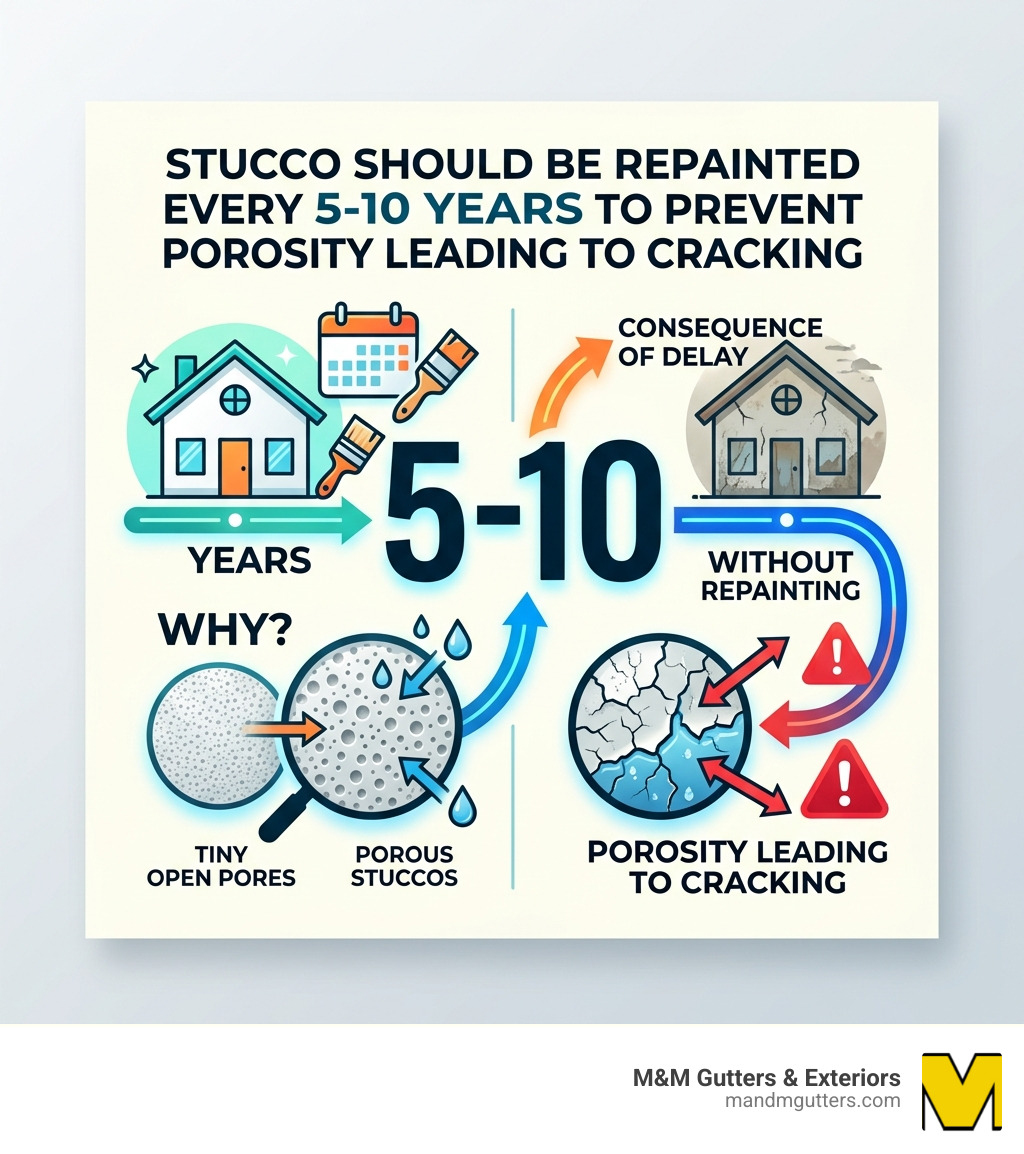
The general rule of thumb is every 5 to 10 years. Because stucco is porous, the paint acts as a seal. Once that seal breaks down, water can get in, freeze, and cause the stucco to pop off the wall (spalling). Regular painting is much cheaper than a full stucco tear-off!
Can I match 40-year-old stucco without repainting the whole house?
Yes, but with a caveat. You can match the color for a small patch, but because of the way light hits the texture, the patch will almost always be visible if you just “spot paint.” The best way to make a 40-year-old wall look seamless is to match the color as closely as possible and then repaint that entire specific wall section from corner to corner.
What are the best colors for Utah stucco exteriors?
In Northern Utah, we love our earth tones. Because our homes often sit against a backdrop of the Wasatch Mountains or the Oquirrhs, colors like Stucco Tan (BWC-26), warm grays, and sage greens are incredibly popular.
- Heat Reflection: Lighter colors are better for our hot summers, as they reflect more UV rays and keep the home cooler.
- Neighborhood Harmony: Always look at your neighbors’ homes. You want to stand out for your beautiful home, not because your house is the only neon blue one in the cul-de-sac!
For more inspiration on what works in our local climate, see our article on the Best Siding for Utah Homes.
Conclusion
Stucco siding paint matching is as much an art as it is a science. Between the unique UV challenges of the Salt Lake Valley and the technical requirements of high-alkalinity masonry, it’s a project that requires patience and the right materials.
At M&M Gutters & Exteriors, we’ve spent over 30 years perfecting the look of Utah homes. We don’t just guess at colors; we use advanced tools like HOVER 3D visualization to help you see exactly how your home will look before we ever open a paint can. Whether you are in Salt Lake, Davis, or Utah County, we are your local experts in making sure your home’s exterior is both beautiful and weather-tight.
Don’t let a mismatched patch ruin your curb appeal. Get a professional stucco and stone siding consultation with us today, and let’s make sure your home is “color impressed!”