


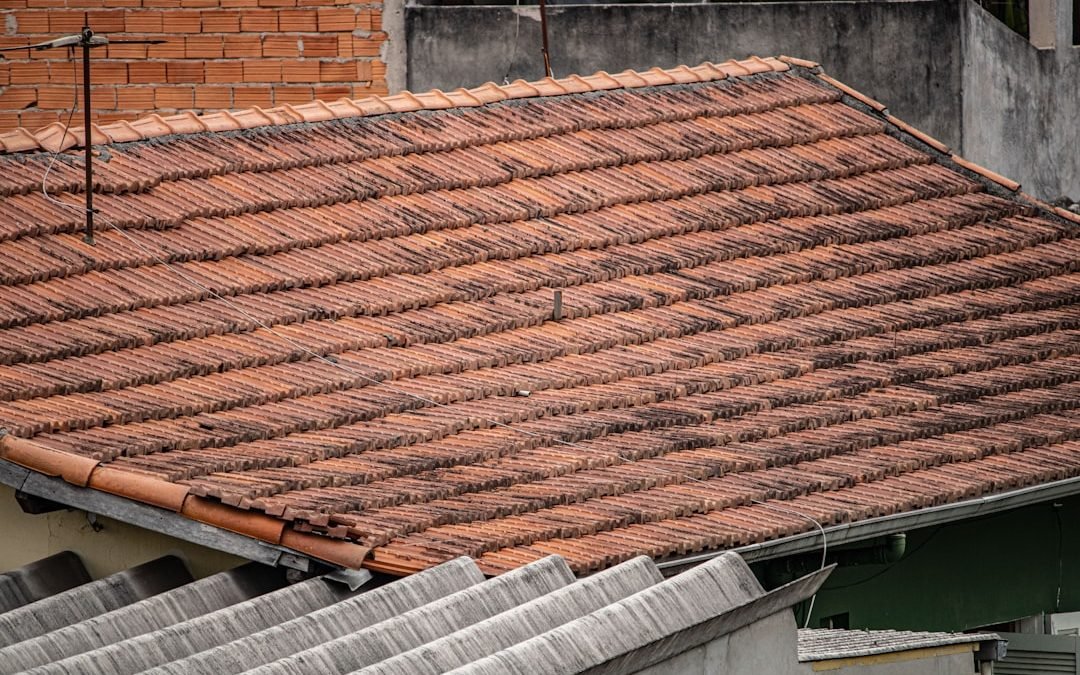
Why 40 Pound Roofing Felt Matters for Your Utah Roof
40 pound roofing felt is a heavy-duty asphalt-saturated underlayment that provides superior protection for your roof, especially under concrete or clay tile installations. Here’s what you need to know:
Quick Facts:
- Coverage: 216 sq. ft. per roll (true 2-square coverage)
- Weight: 75-78 lbs per roll
- Thickness: 55 mils (nominal)
- Exposure Limit: Up to 180 days uncovered
- Best For: Tile roofs, metal roofing, hot climates
- Standards: Meets ASTM D2626-04, UL Type 15
Key Advantages:
- 35% stronger tear resistance than 30-pound felt
- Better nail sealability (flexes and seals around fasteners)
- Resists wrinkling and buckling in hot weather
- Thicker protection layer (nearly double #15 felt)
When you’re investing in a new roof or re-roofing project in Utah, understanding your underlayment options can save you thousands in potential water damage down the road. The underlayment sits directly on your roof deck, creating a critical secondary barrier against moisture before your shingles or tiles go on. While lighter options like #15 or #30 felt exist, 40 pound roofing felt offers significantly more protection—especially important for our region’s temperature extremes and the weight of tile roofing systems.
The confusion around roofing felt weights is real. You might hear contractors talk about “#30 felt” or “40-pound felt” and wonder what those numbers actually mean. Here’s the truth: these designations used to represent the actual weight per 100 square feet, but industry standards have changed. Today’s “#30 felt” typically weighs only 16-27 pounds per square, while true 40 pound roofing felt still delivers close to its nominal weight—making it a genuinely heavier-duty option.
I’m Nathan Nuttall at M&M Gutters & Exteriors, and over our 30+ years serving Utah homeowners, I’ve seen how proper underlayment selection—including when to specify 40 pound roofing felt—makes the difference between a roof that lasts decades and one that fails prematurely. This guide will walk you through everything you need to know about this premium underlayment option, from technical specs to real-world performance.
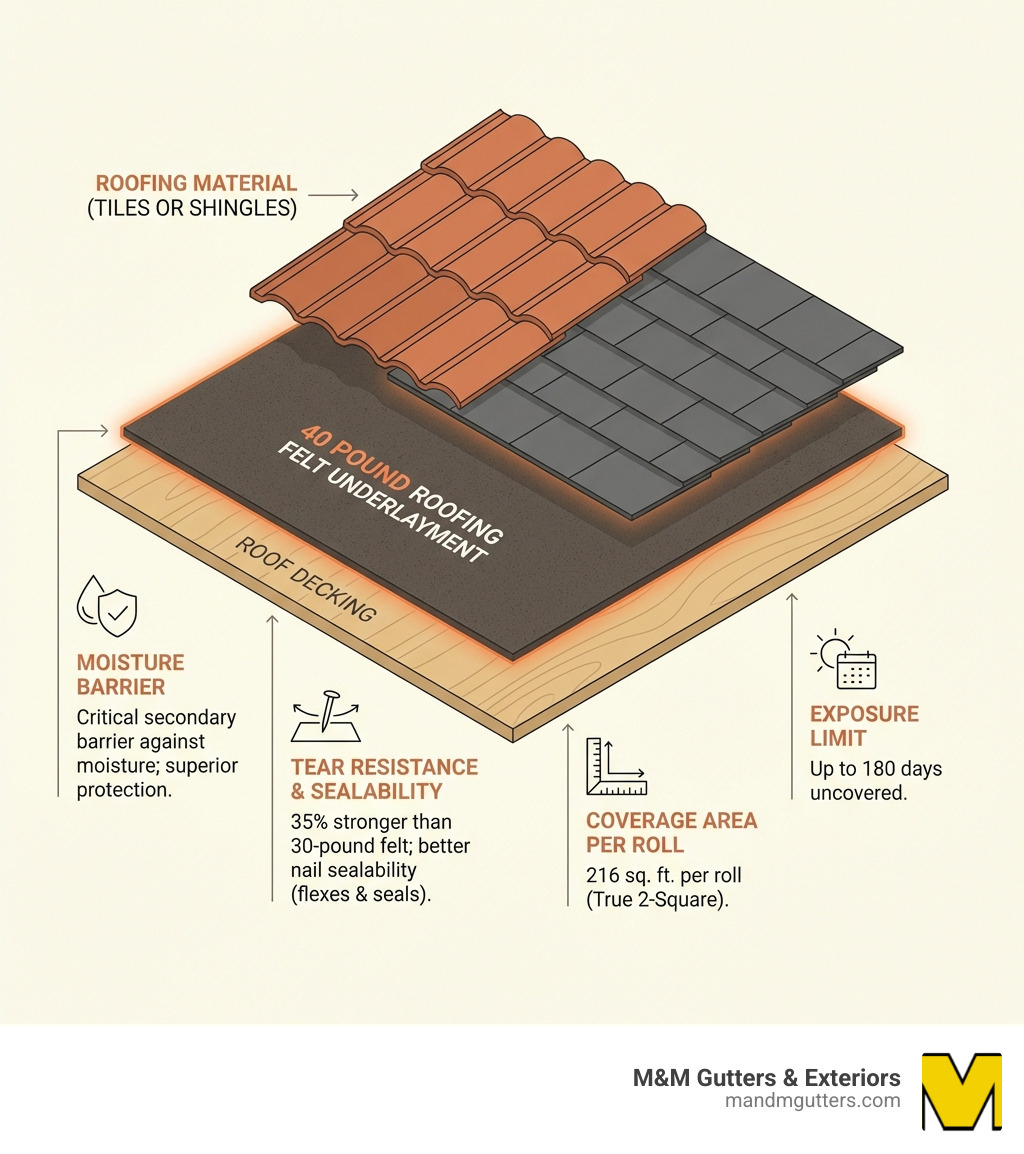
40 pound roofing felt terminology:
Understanding 40 Pound Roofing Felt and Technical Specifications
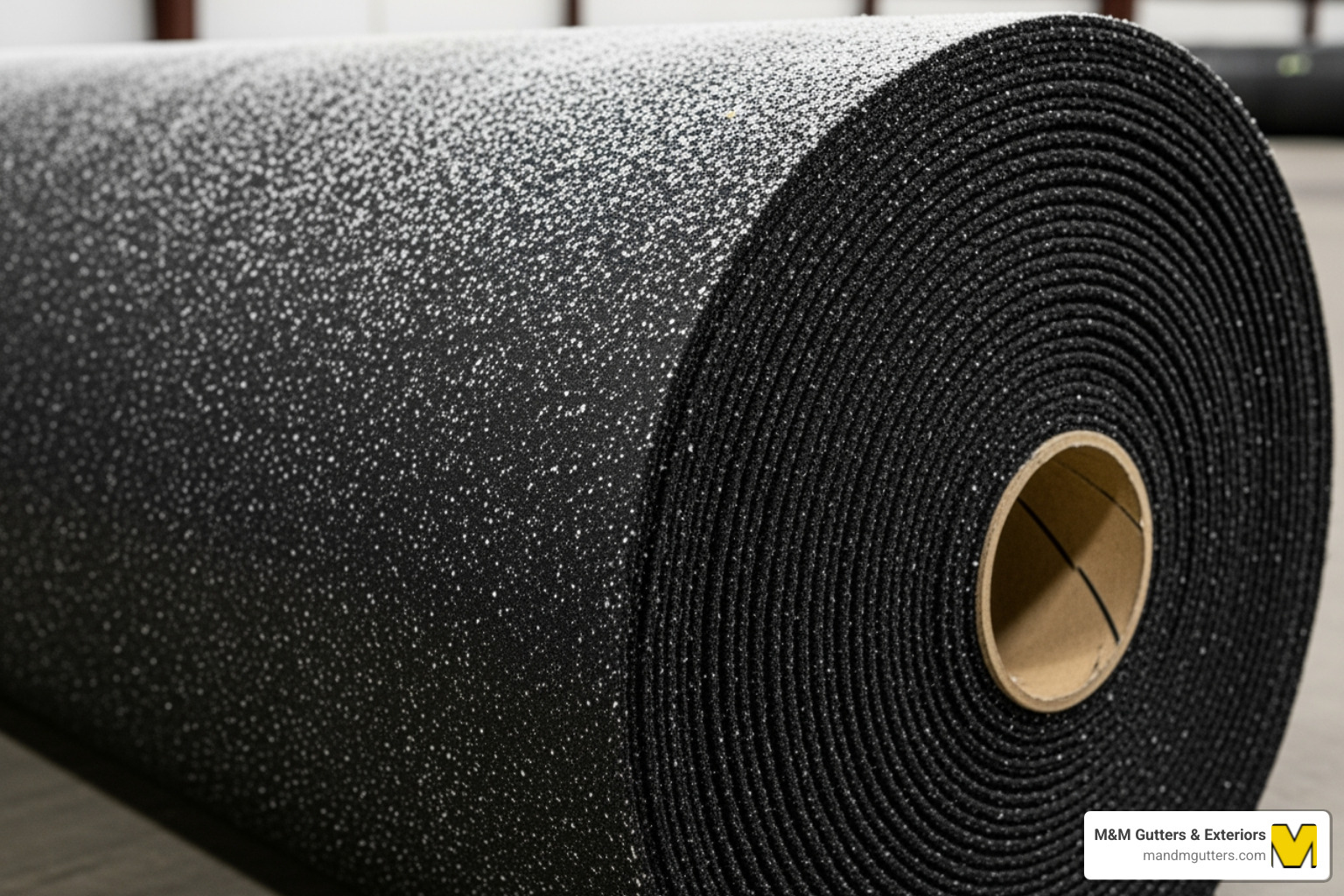
When we talk about what is roofing felt?, we are describing the unsung hero of your roofing system. While the tiles or shingles get all the glory, the underlayment does the heavy lifting of keeping the plywood deck dry. 40 pound roofing felt, specifically, is a high-quality, premium organic base sheet. It is manufactured by taking a heavy mat of organic fibers (often recycled paper) and saturating it completely with asphalt.
What sets the 40-pound version apart from its lighter cousins is the extra coating of weathering-grade asphalt on both sides. To keep the roll from becoming one giant, sticky mess in the Utah summer heat, manufacturers apply “mineral surface fines”—essentially tiny granular particles—to the top.
Technical Data and Compliance
If you’re a fan of the technical details (or just want to make sure your contractor is using the right stuff), you’ll want to look for compliance with ASTM D2626. This is the standard specification for asphalt-saturated and coated organic felt base sheets.
Here is how 40 pound roofing felt stacks up against standard #15 and #30 options:
| Specification | #15 Felt | #30 Felt | 40-Pound Felt |
|---|---|---|---|
| Typical Roll Weight | 30-45 lbs | 45-55 lbs | 75-78 lbs |
| Coverage per Roll | 400-432 sq. ft. | 216 sq. ft. | 216 sq. ft. |
| Thickness (Nominal) | 20-30 mils | 30-40 mils | 55 mils |
| Asphalt Saturation | Standard | High | Maximum |
| ASTM Standard | D226 Type I | D226 Type II | D2626 |
Key Specifications for 40-Pound Felt:
- Roll Dimensions: Typically 36 inches wide by 72 feet long, or 39.375 inches wide for some specialized brands.
- Coverage: Provides a “true 2 square” coverage (216 sq. ft.), allowing for the necessary overlaps.
- Mass of Asphalt Saturant: Approximately 7.2 lbs per 100 sq. ft.
- Mass of Desaturated Felt: Approximately 5.2 lbs per 100 sq. ft.
- Breaking Strength: Minimum of 35 lbf/in in the machine direction and 20 lbf/in in the cross direction.
According to the Asphalt Roofing Manufacturers Association: Frequently Asked Questions, using a heavier base sheet like this provides a much more robust “cushion” for the roof, which is vital when you’re installing heavy materials like concrete tile.
Key Advantages of Using 40 Pound Roofing Felt
Why choose 40 pound roofing felt when #30 is cheaper? In the roofing world, you often get what you pay for, and with 40-pound felt, you are paying for peace of mind.
Superior Tear Resistance and Pliability
If you’ve ever seen a roofer walking on standard felt during a windy day in Davis County, you’ve probably seen the paper tear around the nails. 40 pound roofing felt is significantly tougher. Its high breaking strength means it stays put, even under foot traffic or high winds during the construction phase.
Furthermore, premium versions of this product are often SBS-modified. SBS (Styrene-Butadiene-Styrene) is a type of rubber that is blended into the asphalt. This makes the felt more pliable, meaning it can expand and contract with Utah’s wild temperature swings without cracking. It also prevents the dreaded “bacon effect”—where the felt wrinkles and buckles under the shingles, creating an uneven look on your roof.
Exceptional Nail Sealability
One of the most overlooked benefits is nail sealability. When a roofer drives a fastener through the underlayment, they are creating a hole. 40 pound roofing felt, being thicker and more asphalt-rich, actually “grips” the nail. The asphalt flexes and creates a gasket-like seal around the fastener, preventing water from seeping through the nail hole. This is a massive advantage over thin synthetics that might not seal as effectively around every single nail.
180-Day Exposure Limit
Utah construction schedules can be… unpredictable. Whether it’s a sudden snowstorm in Weber County or a delay in tile delivery, your roof might sit “dried-in” (meaning only the underlayment is installed) for weeks. While standard felt might degrade or curl after just a few days of UV exposure, many 40-pound products are rated for 180 days of uncovered exposure.
For more on choosing the right grade, check out our guide on Choosing your felt: A deep dive into ASTM D226 Type 1 and Type 2.
Common Applications for 40 Pound Roofing Felt
While you can use 40 pound roofing felt under standard asphalt shingles, it is often considered “overkill” for a basic roof. However, for certain high-end systems, it isn’t just a recommendation—it’s often a requirement.
The Gold Standard for Tile Roofs
If you are installing concrete or clay tiles in Salt Lake County, 40 pound roofing felt is likely your best friend. Tile roofs are heavy, and the tiles themselves can be abrasive. This heavy-duty felt acts as a critical cushioning layer between the rigid tile and the wood deck.
Because tile roofs are “water-shedding” rather than “water-tight” (water can get under the tiles during wind-driven rain), the underlayment is actually the primary waterproofing layer. Using a thin #15 felt under tile is like wearing a paper poncho in a hurricane—it’s just not going to end well.
Metal and Built-Up Roofing (BUR)
For metal roofing, the thickness of the 40-pound felt helps dampen sound and provides a sturdy base that won’t tear as the metal panels expand and contract. It is also frequently used as a “base sheet” in built-up roofing systems, where multiple layers are mopped together with hot asphalt.
As noted in InspectAPedia: Roof Underlayment Requirements and Recommendations, the underlayment must be compatible with the top-layer material. 40 pound roofing felt meets the What is ASTM D226? physical requirements while offering the added thickness needed for steep-slope tile applications.
Performance in Hot Arid Climates
In Northern Utah, our summers are brutal. Traditional fiberglass-based underlayments can sometimes hold onto heat, which isn’t ideal for the longevity of the roof deck. 40 pound roofing felt, specifically the organic variety, has excellent thermal stability. It doesn’t get as brittle in the heat, and the mineral surface helps reflect a small portion of UV rays while providing a safer, slip-resistant surface for our crews to walk on.
Installation Best Practices and Code Compliance
Even the best 40 pound roofing felt will fail if it’s installed by someone who doesn’t know their way around a hammer. At M&M Gutters & Exteriors, we follow strict protocols to ensure the underlayment performs as intended.
1. Deck Preparation
The roof deck must be clean, dry, and smooth. Any protruding nails or warped boards can puncture the felt. In Utah, we also have to be mindful of “ice dam” zones. We often combine 40-pound felt with ice and water shields at the eaves for maximum protection.
2. Mechanical Attachment
40 pound roofing felt should be attached using mechanical fasteners—specifically, 1-inch head nails (often called “plastic caps” or “tin caps”). These provide much better holding power than staples and prevent the felt from blowing off or tearing at the fastener point.
3. Handling the Weather
- Cold Weather: If we’re installing in the middle of a Tooele County winter, the felt can become stiff. A pro tip is to let the rolls sit in the sun for a bit to warm up before unrolling. This makes them much more pliable and easier to lay flat.
- Hot Weather: Laying the felt flat is crucial. If it’s installed with “bubbles” or wrinkles, those will never go away and could interfere with how the tiles sit.
4. Overlap Requirements
For standard slopes, a 2-inch side lap and a 4-inch end lap are typical. However, for lower slopes (between 2:12 and 4:12), we often recommend a “double coverage” method. This involves overlapping each sheet by 19 inches, effectively creating two layers of 40-pound protection across the entire roof.
5. Proper Storage
This is a big one. 40 pound roofing felt rolls must be stored standing on end in a dry, cool area. Never lay them on their sides for long periods, as they can become “egg-shaped” or compressed, making them nearly impossible to unroll straight. And definitely don’t double-stack the pallets!
Frequently Asked Questions about 40 Pound Roofing Felt
How does 40 pound roofing felt compare to synthetic underlayment?
This is the “great debate” in modern roofing. Synthetic underlayments are made from spun-bonded polyethylene or polypropylene. They are incredibly light and very hard to tear.
However, 40 pound roofing felt still wins in a few categories:
- Nail Sealing: The thick asphalt in 40-pound felt seals around nail penetrations better than many basic synthetics.
- Heat Management: In hot, arid climates like Utah, some roofers prefer the thermal properties of asphalt-saturated organic felt over plastic-based synthetics.
- Cost-Effectiveness: While synthetics are becoming more competitive, 40-pound felt remains a high-value, heavy-duty option for tile roofs.
Does 40 pound roofing felt actually weigh 40 pounds?
Not exactly. This is a common misconception. Historically, #15 felt weighed 15 lbs per “square” (100 sq. ft.), and #30 weighed 30 lbs. Over time, manufacturers made the products thinner while maintaining strength.
Today, a “40-pound” product typically refers to its classification as a heavy-duty base sheet. A single roll of 40 pound roofing felt (covering 200-216 sq. ft.) usually weighs between 75 and 78 pounds. So, if you’re doing the math, it actually weighs about 37-39 lbs per square—very close to its namesake!
What is the maximum exposure limit for 40 pound felt?
Most standard felts should be covered within days. However, premium 40-pound organic base sheets are designed to withstand the elements during the “dry-in” phase. Many are rated for 180 days (6 months). This is thanks to the high-quality, weathering-grade asphalt coating that resists UV degradation much longer than cheaper alternatives.
Conclusion
Choosing the right underlayment is about more than just checking a box on a contract; it’s about protecting your home from the unique challenges of the Utah climate. From the heavy snow loads in Summit County to the blistering summer sun in Salt Lake City, your roof deck needs a barrier that won’t quit.
40 pound roofing felt offers the thickness, nail-sealing capability, and durability that lighter felts simply can’t match. Whether you are planning a stunning new tile roof or looking for a heavy-duty base for a metal system, this “old school” material remains a top-tier choice for modern homes.
At M&M Gutters & Exteriors, we bring over 30 years of experience to every project across Northern Utah. We don’t just guess which materials are best; we use advanced tools like HOVER 3D visualization to help you see exactly how your new roof will look and perform. If you’re ready to upgrade your home’s exterior with a team that understands the “nuts and bolts” (and the asphalt and felt) of quality roofing, we’re here to help.
Get a professional roofing quote and let’s make sure your Utah home is protected for the next 30 years and beyond!