


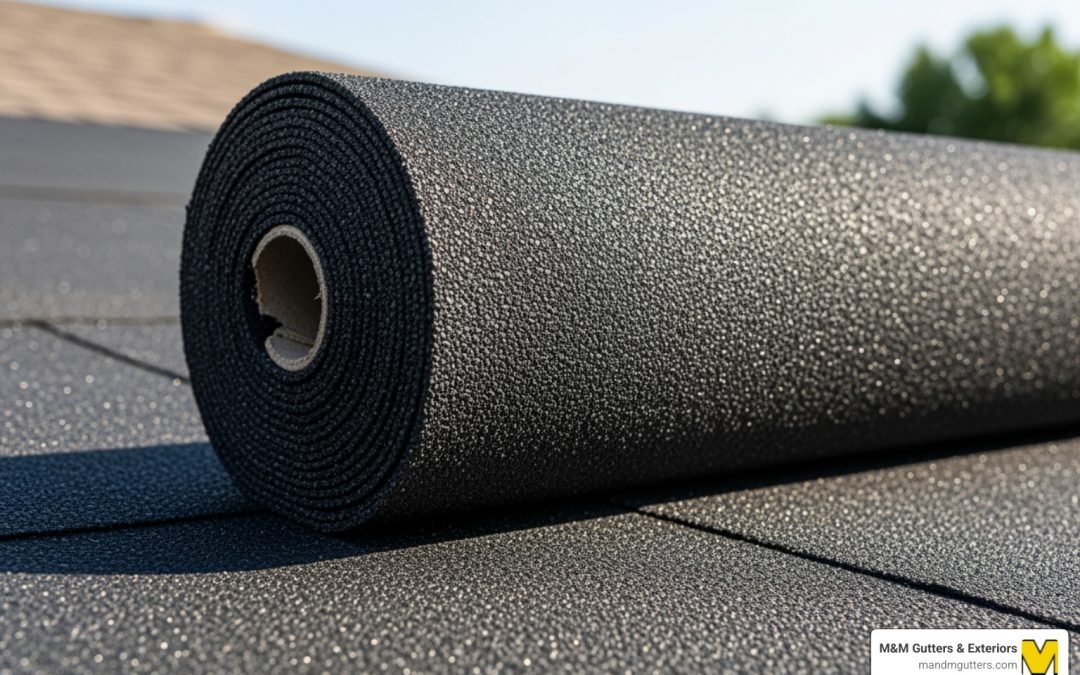
What You Need to Know About 90 Pound Roofing Felt
90 pound roofing felt is a heavy-duty, mineral-surfaced roll roofing product designed primarily for low-slope roofs. It is not the same as standard felt underlayment — it functions as a standalone roof surface.
Quick answers:
- What it is: A roll roofing membrane made from a fiberglass or organic mat, coated with asphalt, and topped with ceramic mineral granules
- What it’s used for: Low-slope roofs on sheds, porches, utility buildings, and similar structures
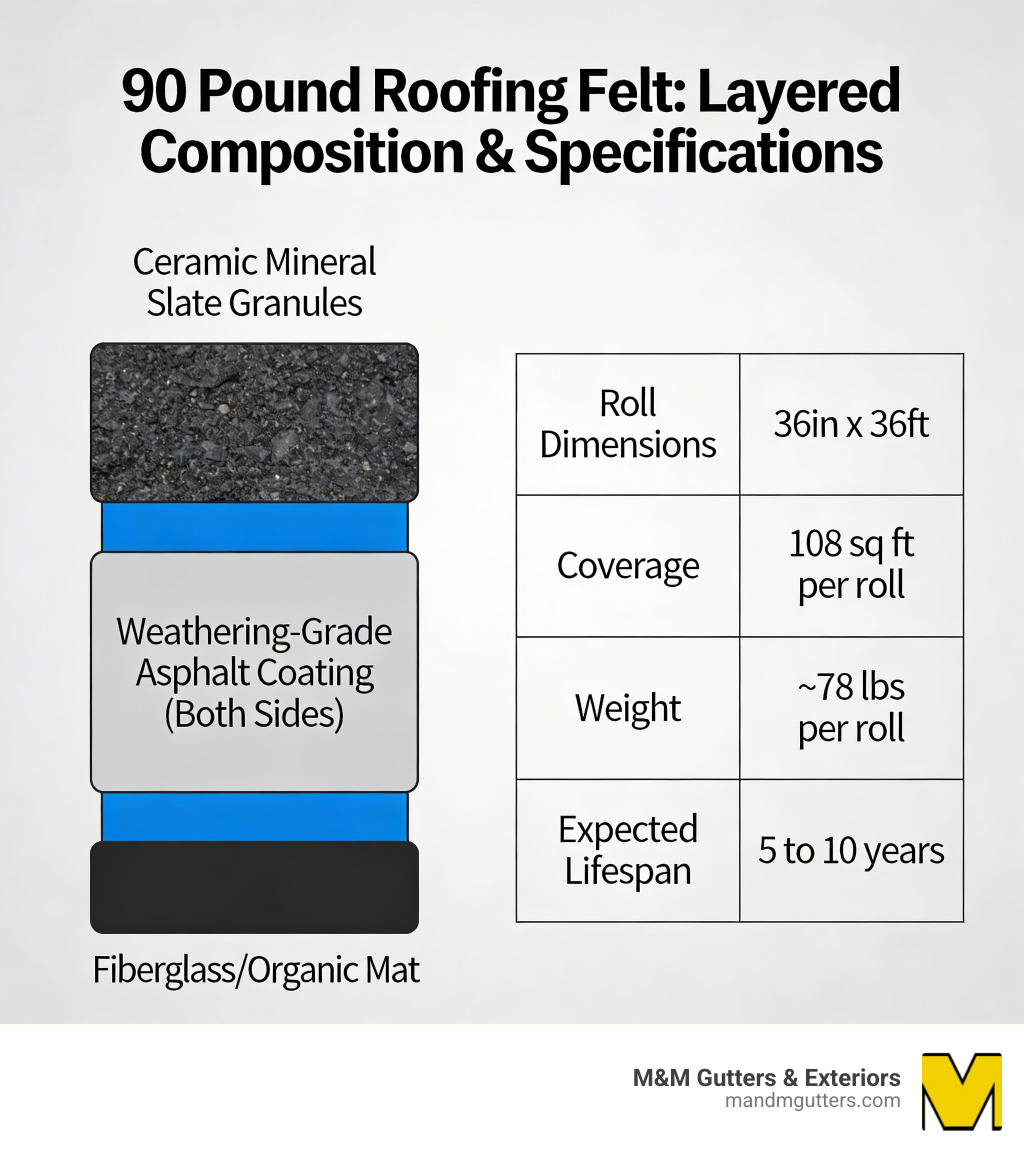
- How long it lasts: Roughly 8 to 10 years when properly sealed; often closer to 5 years on very low slopes
- Can it replace underlayment? No — it is a surface covering, not an underlayment
- Typical roll size: Approximately 36 inches wide by 36 feet long, covering 1 square (108 sq ft)
- Typical cost: Around $150–$160 per roll for quality products
Despite the name, 90 pound roofing felt is not felt paper like #15 or #30. It is heavier, thicker, and built to be the final exposed layer on a roof — not a layer hidden beneath shingles.
I’m Nathan Nuttall from M&M Gutters & Exteriors, and after 30+ years helping Utah homeowners with roofing projects, I’ve seen how often 90 pound roofing felt is misunderstood — and misinstalled. Let’s break down exactly what it is, where it works, and where it falls short.
Simple 90 pound roofing felt word guide:
What is 90 Pound Roofing Felt?
To understand 90 pound roofing felt, we first have to clear up a major naming confusion. In the roofing world, “felt” usually refers to the thin, black paper you put under shingles. However, #90 (as it’s often called) is actually mineral-surfaced roll roofing.
Its composition is much more robust than standard underlayment. It typically features a strong fiberglass mat—though some older versions used an organic mat—that is saturated and coated on both sides with weathering-grade asphalt. To provide protection against the sun and foot traffic, the top surface is embedded with ceramic mineral granules, much like the surface of a standard asphalt shingle.
Because of this heavy coating and granule layer, it is significantly thicker than underlayment. If you are wondering how thick is roofing felt, standard #15 felt is paper-thin, while 90 pound roofing felt can be upwards of 50 to 90 mils thick. It is designed to be the “roof” itself, not just a backup layer.
For a deeper dive into the basics of the “felt” family, you can check out our more info about what roofing felt is guide. In terms of industry standards, while standard underlayments often fall under ASTM D226 or ASTM D4869, #90 roll roofing is built to handle direct exposure to the elements, including snow and UV rays common here in Northern Utah.
Distinguishing #90 from #15 and #30 Felts
The numbers #15, #30, and #90 used to refer to the actual weight of the material per 100 square feet (one “square”). In the old days, 15-pound felt weighed 15 pounds per square. Modern manufacturing has made materials lighter but stronger, so today’s “15-pound” felt might only weigh 8 to 12 pounds.
However, 90 pound roofing felt has stayed true to its heavy-duty roots. It is drastically heavier and tougher than its counterparts.
| Feature | #15 Felt | #30 Felt | #90 Roll Roofing |
|---|---|---|---|
| Primary Use | Underlayment (Steep Slope) | Underlayment (Heavy Duty) | Standalone Roof Surface |
| Weight per Roll | ~30 lbs | ~45 lbs | ~78-90 lbs |
| Coverage | 400 sq. ft. | 200 sq. ft. | 100 sq. ft. |
| Surface | Smooth Asphalt | Smooth Asphalt | Mineral Granules |
| Durability | Low (Tears easily) | Medium | High (Tear resistant) |
When you are choosing between Type 1 and Type 2 felt, you are usually looking for a layer to go under shingles. If you are looking at a low-slope porch or a shed where you don’t want to install individual shingles, #90 is your candidate.
Key Specifications of 90 Pound Roofing Felt
If you’re planning a DIY project or checking a contractor’s quote in Salt Lake County, you need to know the “specs.” While it’s called “90 pound,” a modern roll of G.A.P. or Tarco mineral-surfaced roofing actually weighs about 78 to 80 lbs per roll.
Here are the typical measurements:
- Dimensions: 36 inches wide by 36 feet long (some rolls are 39 3/8″ wide).
- Coverage: 108 square feet. After accounting for the necessary laps (overlaps), one roll covers exactly 1 square (100 square feet) of roof area.
- Thickness: Approximately 50 to 90 mils.
- Packaging: Usually 25 rolls per pallet.
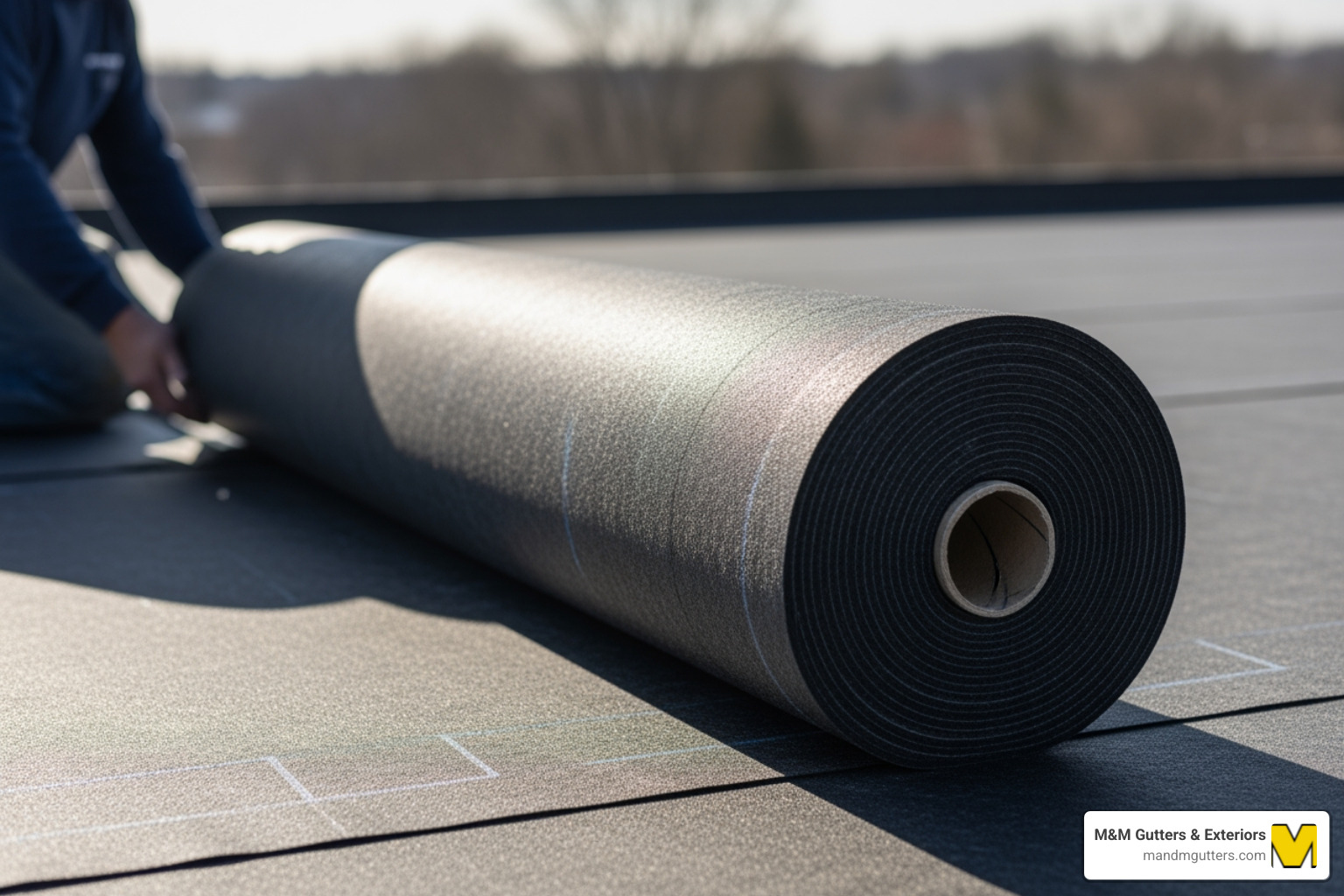
One of the perks of 90 pound roofing felt is the aesthetic variety. Because it uses ceramic slate granules, it comes in several colors to match your main house shingles. Common options include:
- Black/Charcoal: The most popular for a sleek look.
- White: Great for reflecting heat (though it shows dirt faster).
- Brown: Often used for sheds and rustic structures.
- Green: A classic choice for utility buildings and cabins.
Primary Uses and Suitable Applications
In our 30+ years at M&M Gutters & Exteriors, we typically see 90 pound roofing felt used on “low-slope” applications. A low-slope roof is generally defined as having a pitch between 2:12 and 4:12. If your roof is flatter than 2:12, you really should be looking at more robust commercial-grade options like EPDM or TPO.
Common applications include:
- Sheds and Barns: It’s the most economical way to get a finished roof on a utility building.
- Screened Porches: Since porches often have a lower pitch than the main house, #90 is a frequent choice.
- Carports: It provides a quick, water-shedding surface that matches the home.
- Secondary Water Barrier: Sometimes used in very specific valley constructions or as a heavy-duty liner.
It’s important to understand the weights and measures of underlayment for roofing to ensure you aren’t overloading your structure. Because #90 is heavy, the roof deck needs to be solid and in good condition.
While it is widely used across the country and even meets strict standards like the Florida Building Code, here in Utah, we have to consider snow load. If you use #90 on a low-slope roof in Summit County or Weber County, you must ensure the seams are perfectly sealed to prevent ice damming from forcing water under the laps. You can learn more about how different materials handle these slopes in our guide on understanding roofing materials and types.
Installation and Performance of 90 Pound Roofing Felt
Installation is where most people go wrong. Because 90 pound roofing felt is stiff and heavy, it doesn’t “self-heal” or seal as easily as a standard shingle might in the sun.
There are three main ways to install it:
- Cold Adhesive: This is the most common DIY and residential method. A “lap cement” or specialized asphalt adhesive is spread on the deck and at the seams.
- Hot Mopping: This is a professional method involving molten asphalt. It creates an incredibly strong bond but requires specialized equipment and carries higher safety risks.
- Nailing (with Sealed Laps): Nails are used to hold the sheet in place, but the laps must be sealed with adhesive to prevent wind-driven rain from getting underneath.
When installing, always refer to a comprehensive look at roofing felt standards to ensure your project meets local building codes.
Proper Installation of 90 Pound Roofing Felt
To get that 8 to 10-year lifespan, you can’t cut corners. Here is the professional way to do it:
- Preparation: Start with a clean, dry, and smooth deck. Any protruding nails will eventually poke through the felt.
- Drip Edge: Install a T-drip edge at the eaves.
- The “Starter” Strip: Some pros use a 9-inch wide starter strip of the felt itself.
- Lapping: Apply the rolls in a “shingle fashion,” starting from the bottom and working up. Each layer should overlap the one below it by at least 2 to 4 inches. For very low slopes, a 19-inch overlap (double coverage) is often recommended.
- Sealing: Use a generous amount of lap cement at every seam. If you see “wrinkles” or “fishmouths,” the material wasn’t rolled out flat or the adhesive wasn’t applied evenly. These wrinkles are the #1 cause of premature leaks.
- Edge Work: Use gravel guards or snipped and folded drip edges at the corners to ensure water is directed away from the fascia.
Common DIY Mistake: Many people try to “nail only.” Without adhesive at the seams, wind will eventually lift the edges, and capillary action will pull water right under the felt and into your plywood.
90 Pound Roofing Felt vs. Modified Bitumen
We often get asked: “Is this #90 felt or Modified Bitumen (Mod Bit)?” They look very similar because they both come in granulated rolls. However, they are very different beasts.
The Tear Test: The easiest way to tell them apart is to try and tear a small piece. 90 pound roofing felt is made with a fiberglass or organic mat; it is relatively brittle and will tear if you pull hard enough. Modified Bitumen is “modified” with rubber (SBS) or plastic (APP) polymers. It is extremely stretchy and almost impossible to tear by hand.
Comparison at a Glance:
- Underside: Mod Bit usually has a glossy black, smooth underside (especially the torch-down or peel-and-stick versions). #90 felt usually has a duller, asphalt-saturated finish.
- Durability: Mod Bit can last 15–20 years. #90 felt typically lasts 5–10 years.
- Installation: Mod Bit often requires a torch or is self-adhered. #90 felt is usually “mopped” or glued.
- Price: 90 pound roofing felt is significantly cheaper, making it the “budget” choice for utility structures.
Pros, Cons, and Limitations
Using 90 Pound Roofing Felt as a Standalone Surface
Is it right for your project? Let’s weigh the options.
The Pros:
- Cost-Effective: It is one of the cheapest ways to cover a low-slope roof.
- DIY Friendly: Unlike torch-down roofing (which can literally burn your house down if you aren’t careful), #90 felt can be installed with basic tools and cold adhesive.
- Availability: You can find it at almost any hardware store in Salt Lake City or Davis County.
- Breathability: Organic-based felts allow some moisture to escape the building, reducing the risk of rot in certain conditions.
The Cons:
- Short Lifespan: In the harsh Utah sun and snow, don’t expect more than 10 years. On flat roofs with ponding water, it might only last 5.
- Maintenance: You need to check the seams every year. If the adhesive dries out and cracks, leaks follow immediately.
- Fragility: It becomes brittle in the winter. If you walk on it when it’s freezing, you can crack the membrane.
- UV Sensitivity: Once the granules start to rub off (granule loss), the asphalt underneath degrades rapidly under UV light.
Frequently Asked Questions about 90lb Felt
Is 90-pound roofing felt the same as underlayment?
No. While it has the word “felt” in the name, it is a roll roofing membrane. Standard underlayment (like #15 or #30) is meant to be covered by shingles. 90-pound felt is meant to be the final, exposed layer of the roof. Using it as an underlayment is generally a waste of money and can create a surface that is too “slick” for shingles to bond to properly.
Can you install 90-pound felt over an existing roof?
While some people do it, we don’t recommend it. Installing new #90 over an old, wrinkled roof will result in a “telegraphed” finish—meaning the new roof will be just as lumpy as the old one. This creates water pockets and speeds up failure. It’s always better to tear off the old material to inspect the wood deck for rot.
How do you identify 90-pound felt on an existing structure?
Look at the seams and the texture. If it’s a 3-foot wide roll with mineral granules and it feels somewhat “papery” or brittle when you pick at an edge, it’s likely 90 pound roofing felt. If it feels rubbery and thick, you’re likely looking at Modified Bitumen.
Conclusion
90 pound roofing felt is a reliable, budget-friendly solution for low-slope utility buildings, sheds, and porches. It provides a finished look that matches your shingles without the complexity of a commercial roofing system. However, its performance depends entirely on the quality of the installation—specifically how well those seams are sealed.
At M&M Gutters & Exteriors, we’ve spent over 30 years serving Salt Lake City and the surrounding counties. We know that a roof is only as good as its weakest point. Whether you’re looking for a quick shed roof or a full residential replacement, we bring the expertise and 3D visualization tools to ensure the job is done right the first time.
Don’t leave your low-slope roof to chance. If you’re in Northern Utah and need a professional eye on your next project, reach out to us today.