


What Does It Really Cost to Install Rain Gutters?
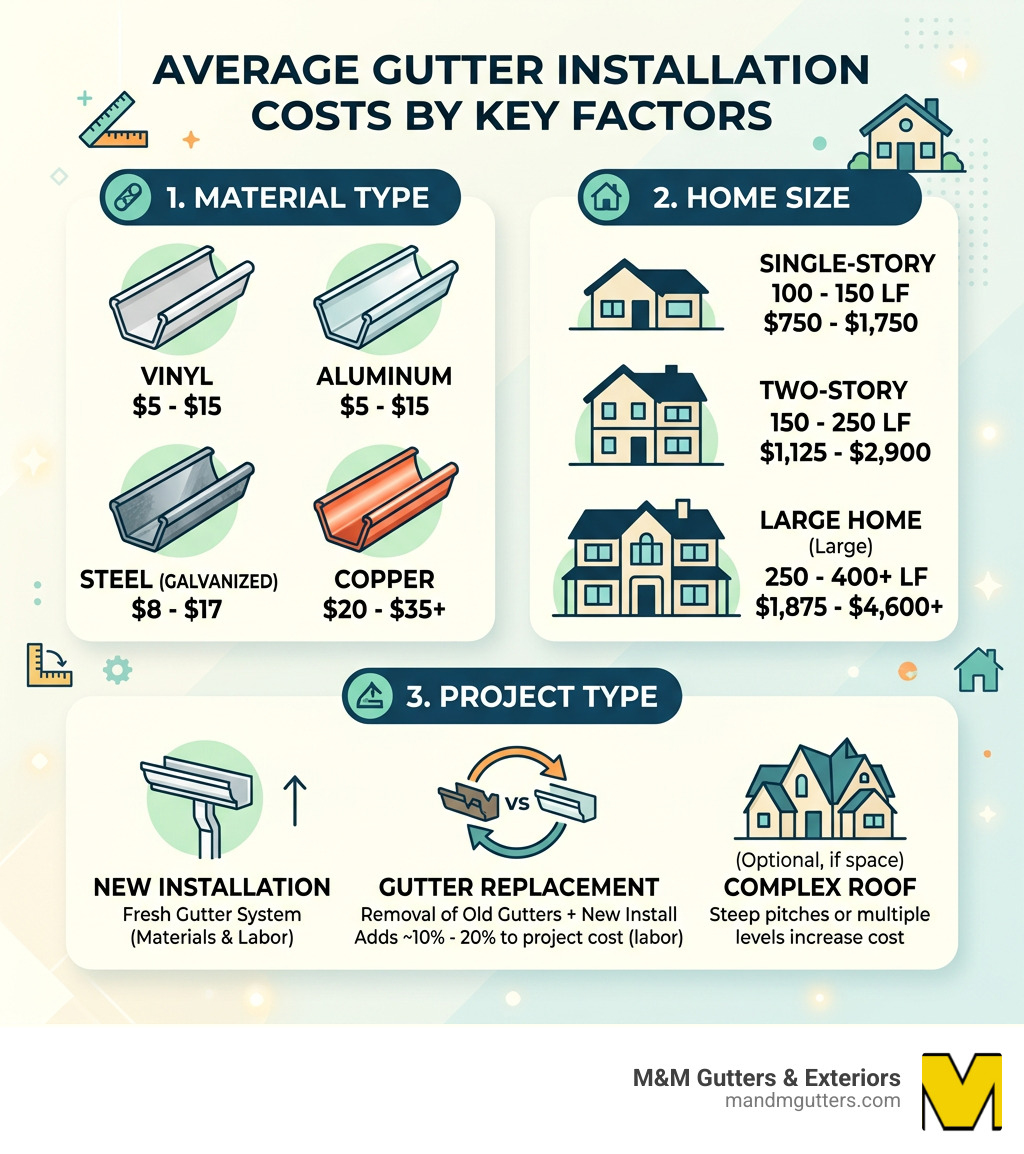
The average cost to install rain gutters runs between $750 and $2,300 for a typical home, or roughly $5 to $15 per linear foot installed. Here’s a quick breakdown to help you budget fast:
| Scenario | Estimated Cost |
|---|---|
| Per linear foot (new install) | $5 – $15 |
| Per linear foot (replacement) | $6 – $17 |
| Typical home (150 linear feet) | $750 – $2,300 |
| National average project cost | ~$1,174 |
| Full replacement (average) | ~$4,000 |
| Premium materials (copper, etc.) | Up to $6,000+ |
Most homes need between 150 and 250 linear feet of gutters. Your final price depends on material choice, home size, roof complexity, and whether you’re replacing existing gutters or starting fresh.
Prices vary by region too. Homeowners in Jacksonville, FL typically pay $700 to $1,800, while costs in markets like Salt Lake City shift based on local labor rates and material availability.
I’m Nathan Nuttall from M&M Gutters & Exteriors, and after 30 years helping Utah homeowners with rain gutter installation, I’ve seen how confusing gutter pricing can be. In this guide, I’ll walk you through everything that affects the average cost to install rain gutters so you can budget with confidence and avoid overpaying.
Average Cost to Install Rain Gutters: National and Regional Trends
When you start digging into the numbers, you’ll find that the national average for gutter installation is roughly $1,174, with a typical range falling between $627 and $1,723. However, “average” is a tricky word in the home improvement world. For a complete, high-quality professional installation on a standard single-family home, many homeowners find themselves in the $2,300 range, especially when factoring in modern materials and professional labor.
In our neck of the woods—Salt Lake City and across Northern Utah—the average cost to install rain gutters can be influenced by our unique climate. We deal with heavy snow loads and rapid freeze-thaw cycles, which means the “cheap” options often end up costing more in repairs down the road. While national data suggests a range of $5 to $15 per linear foot, specific regional data for Utah shows that high-quality installations can range from $14.00 to $22.55 per linear foot depending on the complexity of the system and the durability of the materials chosen.
It’s helpful to look at how other markets compare to understand the variables. For example, in Jacksonville, FL, the standard project might hover around $1,171, while the Austin, TX market sees a wide variety of quotes, sometimes ranging from $2,000 for a standard setup to much higher for premium branded systems. At M&M Gutters & Exteriors, we believe in transparency. Understanding What is the Average Cost of Rain Gutters? helps you spot when a quote is “too good to be true” or when a premium provider is overcharging for basic work. For more detailed price tracking, resources like the Cost to Install Gutters – 2026 Price Guide – Inch Calculator provide a great baseline for current market shifts.
Key Factors Influencing Your Gutter Installation Estimate
No two houses are exactly alike, which is why we don’t just give one-size-fits-all prices over the phone. Several logistical factors will swing your estimate one way or the other.
Linear Footage and Home Height
The most obvious factor is the size of your roofline. Most standard homes require between 150 and 250 linear feet of gutters. However, it isn’t just about length; it’s about height. If you have a two-story home, expect labor costs to increase significantly—sometimes by as much as 80%. Working on high ladders or scaffolding requires more safety equipment and more time, which naturally impacts the average cost to install rain gutters.
Roof Pitch and Complexity
A steep roof isn’t just a challenge for Santa; it’s a challenge for gutter installers. Steep pitches require specialized hangers and more careful positioning to ensure water doesn’t overshoot the gutter during a heavy Utah downpour. If your roof has multiple gables, valleys, and dormers, the installation becomes more complex, requiring more miters (corners) and custom fittings.
Accessibility and Obstacles
Can we easily get a ladder to your roofline? If your home is surrounded by dense landscaping, narrow alleyways, or steep hills, the labor time increases. We want to ensure we protect your prize-winning rose bushes while we work, and that extra care takes time.
The Condition of Your Fascia and Soffit
This is the “hidden” factor that catches many homeowners off guard. Gutters are mounted to the fascia board. If that wood is rotted or water-damaged—which often happens if your old gutters were failing—it must be replaced before the new system can be installed. Installing new gutters on rotted wood is like building a house on sand; it just won’t hold. Fascia repairs can add anywhere from $6 to $22 per linear foot to your total project cost.
| Home Type | Linear Feet (Est.) | Estimated Cost Range |
|---|---|---|
| Small Single-Story (Ranch) | 100 – 150 LF | $600 – $1,600 |
| Average Two-Story Home | 150 – 250 LF | $1,500 – $3,500 |
| Large Custom Estate | 300+ LF | $4,500 – $7,500+ |
Average Cost to Install Rain Gutters by Material Type
Material choice is the biggest “lever” you can pull to adjust your budget. We always recommend choosing a material that fits both your wallet and the long-term needs of your home. You can dive deeper into the specifics in our Rain Gutter Materials Guide.
- Vinyl Gutters ($3 – $9 per foot): These are the budget-friendly option. They are lightweight and won’t rust. However, in Utah’s extreme temperature swings, vinyl can become brittle and crack. We generally suggest these for homeowners on a very tight budget who may not plan to stay in the home long-term.
- Aluminum Gutters ($5 – $18 per foot): The “goldilocks” of the industry. Aluminum is rust-resistant, comes in a huge variety of colors, and is very durable. For residential homes, we typically recommend a thickness (gauge) of .027 or .032. It’s the most popular choice for a reason—it offers the best balance of cost and performance.
- Galvanized Steel ($8 – $27 per foot): These are incredibly strong and can handle heavy snow and ice. However, they are prone to eventually rusting if they aren’t maintained perfectly.
- Zinc and Copper ($25 – $100+ per foot): These are the “luxury” choices. Copper gutters are stunning and develop a beautiful green patina over time. They can last 50 to 100 years. While the upfront average cost to install rain gutters using copper is high, you likely won’t ever have to replace them again.
Average Cost to Install Rain Gutters: Seamless vs. Sectional
If you’ve been researching gutters, you’ve likely heard the term “seamless.” But what does that actually mean for your bank account?
Sectional gutters come in pre-cut pieces that you (or a contractor) snap together. Every joint is a potential leak point. Over time, the sealant in those joints fails, leading to drips that can damage your foundation.
Seamless gutters are fabricated on-site. We bring a “gutter factory on wheels” to your driveway—a machine that extrudes a single, continuous piece of metal to the exact length of your roofline. The only seams are at the corners.
- Sectional Cost: $3 to $20 per linear foot.
- Seamless Cost: $8 to $28 per linear foot.
While the upfront investment for seamless is higher, the long-term value is undeniable. They require less maintenance, look much cleaner, and significantly reduce the risk of water damage. For more on this, check out What Are Seamless Rain Gutters? to see why they are the standard for modern Utah homes.
Hidden Costs: Downspouts, Guards, and Repairs
When you get a quote for the average cost to install rain gutters, make sure you’re looking at the entire system, not just the horizontal troughs.
Downspouts and Extensions
Downspouts are the vertical pipes that carry water from the gutter to the ground. You generally need one downspout for every 30 to 40 feet of gutter. These cost between $5 and $20 per vertical foot. Don’t forget the extensions or splash blocks at the bottom! Their job is to move water at least 3 to 4 feet away from your foundation. Without them, your gutters are just dumping water right where you don’t want it.
Gutter Guards
Gutter guards (or screens) are an optional but popular add-on. They prevent leaves, pine needles, and debris from clogging your system. While they add $3 to $25 per linear foot to the initial cost, they can pay for themselves by eliminating the need for professional cleaning twice a year. However, be wary of “maintenance-free” claims. Even with guards, you’ll likely need a quick inspection or rinse every couple of years.
Gutter Flashing
Gutter flashing (or a “drip edge”) is a metal strip that tucks under your shingles and over the back of the gutter. It ensures that water doesn’t “wick” behind the gutter and rot your fascia board. At roughly $20 per foot, it’s a small price to pay to protect your home’s structural integrity.
Hanger Systems
How the gutters are attached matters. Older systems used “spikes and ferrules,” which can pull out over time. Modern systems use hidden screw-in hangers, which are much stronger. While slightly more expensive in terms of hardware, they are essential for Utah’s heavy snow loads. Understanding how long do gutters last? often comes down to the quality of these small components.
Professional Installation vs. DIY: Risks and Rewards
We get it—the “Do-It-Yourself” spirit is strong in Utah. You might see sectional gutter kits at the big-box stores and think, “I can handle that this weekend.” But before you grab the ladder, let’s look at the reality of the project.
The DIY Reality
DIY installation can save you on labor, which usually accounts for 10% to 50% of a professional quote. You’ll pay for materials and your own time. However, you’ll be limited to sectional gutters, which are more prone to leaks. You also have to factor in the cost of tools you might not own, like high-quality crimpers, heavy-duty ladders, and safety harnesses.
The Professional Advantage
When you hire a pro like M&M Gutters & Exteriors, you aren’t just paying for the metal. You’re paying for:
- Safety: Falls from ladders are a leading cause of home improvement injuries. We have the gear and the training to work safely at heights.
- Proper Pitching: Gutters aren’t supposed to be level. They need a very specific “slope” or pitch (usually 1/4 inch for every 10 feet) to ensure water flows toward the downspouts. If the pitch is off, water will pool, leading to mosquitoes, rust, and sagging.
- Specialized Tools: We bring the seamless gutter machine to you, providing a superior product you simply can’t buy at a store.
- Warranties: We offer workmanship warranties. If something isn’t right, we come back and fix it. If your DIY gutter leaks, you’re back on the ladder on a rainy Saturday.
There are many Common Gutter Installation Mistakes that novices make, from using the wrong number of hangers to improper downspout placement. For most, the risks far outweigh the rewards. We’ve written extensively on Why You Shouldn’t Install Your Rain Gutters Yourself because we’ve seen too many “weekend projects” turn into expensive professional rescues.
Frequently Asked Questions about Gutter Costs
Do new gutters increase home value?
While new gutters might not have the “wow” factor of a kitchen remodel, they are a vital part of home maintenance that buyers look for. High-quality, functioning gutters protect the foundation, siding, and landscaping. An absence of gutters or sagging, leaky ones can be a major red flag for home inspectors and can actually decrease your home’s value or deter buyers who fear hidden water damage.
How often should I clean my new gutters?
Even the best gutters need a little love. We recommend cleaning them at least twice a year—once in the spring and once in the fall. If your Salt Lake City home is surrounded by scrub oaks or evergreens, you might need to do it more often. Regular cleaning prevents the weight of wet debris from pulling the gutters away from your house.
When is the cheapest time of year to install gutters?
The “gutter season” usually peaks in the spring and fall when homeowners notice leaks during storms. If you want to save money, try scheduling your installation during the “off-season,” such as late fall or early winter. Many contractors offer promotions or have more flexible pricing when the schedule isn’t as packed.
Are gutters really necessary in Utah?
We see a trend where some new construction homes skip gutters to save on initial costs. In Utah, this is a risky move. Without gutters, melting snow and rain fall directly next to your foundation. In our climate, this leads to basement flooding, foundation cracks, and “heaving” of your concrete walkways when that water freezes. Gutters aren’t just an accessory; they are a shield for your biggest investment.
Conclusion
Investing in your home’s exterior is about more than just aesthetics; it’s about long-term peace of mind. While the average cost to install rain gutters might seem like a significant expense upfront, it is a drop in the bucket compared to the $10,000 to $30,000 you might spend on foundation repairs or mold remediation caused by poor drainage.
At M&M Gutters & Exteriors, we take the guesswork out of the process. With over 30 years of experience serving Salt Lake City and the surrounding counties, we’ve perfected the art of protecting Utah homes. We don’t just guess at what your home needs; we use advanced HOVER 3D visualization technology to show you exactly how different gutter styles and colors will look on your house before we ever cut a single piece of aluminum.
Whether you’re in Davis County, Weber County, or right here in Salt Lake, we’re your one-stop solution for all things exterior. Don’t leave your home’s safety to chance or a “DIY” kit. Get a professional rain gutter installation quote from our team today and see why your neighbors have trusted us for three decades. We’ll help you find the perfect balance of durability, style, and budget to keep your home dry for years to come.